Some things should not wait for the next free routine appointment. Some things should not wait for the next free routine appointment. Telephone the practice and say what is happening, or go to an emergency room, if you have a mole or a mark that has changed shape, colour or size, that has become raised or uneven, or that bleeds, itches or will not heal; a sore anywhere that has not healed in three weeks; a rash that is spreading quickly, especially with fever, blistering, or peeling skin; a painful rash in a band on one side of the body, particularly near an eye; redness that is hot, swollen, tender and spreading, which can be a deep skin infection; a new rash after starting a medicine, especially with mouth or eye involvement; or a child under three months with any widespread rash. If you have been treated here and something is worse rather than better after a procedure, telephone us rather than waiting for the review appointment. We would far rather field a call that turns out to be nothing.
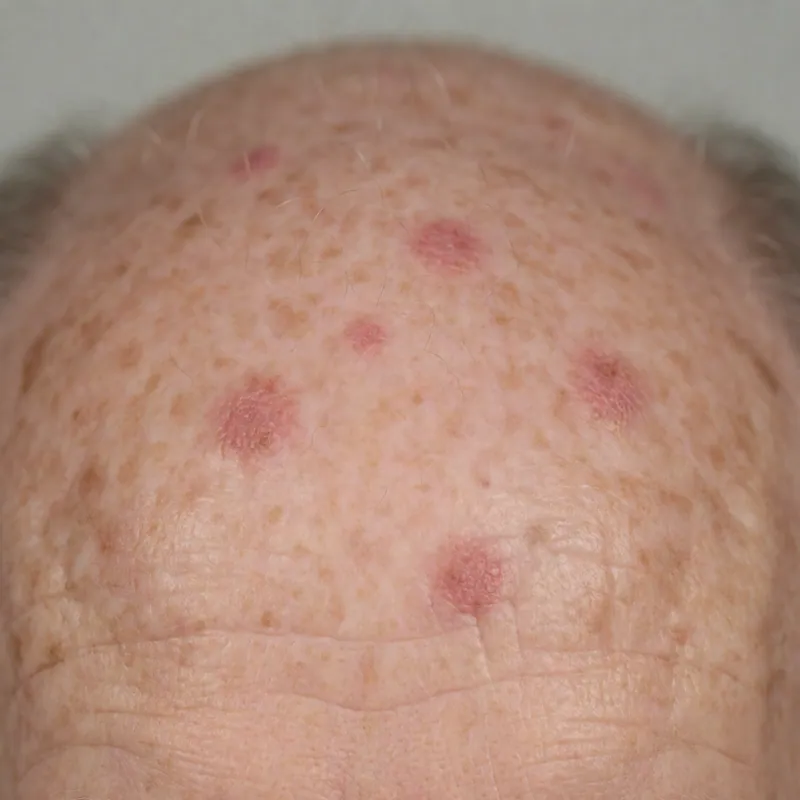
An actinic keratosis is a patch of skin where sun exposure has damaged the cells enough to change how they grow. They appear on the places with the most lifetime exposure — the forehead, the nose, the tops of the ears, a bald scalp, the lower lip, the forearms and the backs of the hands — and they are characteristically easier to feel than to see. Patients routinely find them while washing rather than in a mirror, and describe them as rough or catching rather than as a mark.
The honest position on risk is that the great majority never become anything at all, and some disappear on their own. A small proportion progress to squamous cell carcinoma, and there is no reliable way to tell in advance which ones. That combination — low risk each, no way to identify the ones that matter, and a simple treatment — is what justifies treating them. It also means nobody should be frightened by the word precancerous, which does far more work in advertising than it does in a clinic.
What matters as much as the individual patches is the field around them. Somebody with a dozen of these on a scalp has an area of skin that has all had the same exposure, and treating twelve visible spots leaves the damaged skin between them untouched. That is the reasoning behind field treatment — a cream applied across a whole region for a period of weeks — and it is why a person may be offered that rather than another round of freezing.
Treatment options
Which one is right depends on how many there are, where they are, and how much disruption you can accept.
Cryotherapy
Liquid nitrogen applied in short bursts, freezing the patch so that it blisters and separates over one to two weeks. Quick, effective for individual lesions, done in the appointment. It stings sharply for about twenty seconds, and it usually leaves a pale mark — which on deeper skin tones can be permanent and is a real reason to choose something else.
Field treatment with a prescription cream
Applied by you at home across a whole area for a period of weeks. It treats the damaged skin between the visible patches as well as the patches, which is its advantage. Its cost is that the area becomes red, crusted and genuinely uncomfortable partway through — that reaction is the treatment working, and people stop early unless it has been explained properly and photographed expectations set. We plan these for a period when you can tolerate looking treated.
Curettage, for the thick ones
A patch that has become thick, tender or resistant is scraped off under local anaesthetic, which also provides a specimen. Anything behaving unusually gets this rather than another freeze, because thickness and tenderness are how a squamous cell cancer announces itself.
Chemical peel for the field, in selected cases
A medical-strength peel across a damaged area, which can be appropriate for widespread superficial change. It is a treatment for the skin rather than for the individual lesion and it needs sun avoidance afterwards.
Watching, with a reason
A single flat patch on a forearm in somebody with few of them may reasonably be left alone and reviewed. If that is the plan you will be told what change should bring you back, rather than simply being told not to worry.
What should be sampled rather than frozen
The features that turn a routine patch into a biopsy.
It keeps coming back in exactly the same place
Recurrence at the same site after adequate treatment is the commonest reason to sample rather than repeat.
It has become thick, hard or raised
Thickness is the feature most associated with progression. A patch you can feel as a lump rather than as roughness is a different proposition.
It is tender or painful
Discomfort in a lesion that used to be silent is worth taking seriously and is unusual in a simple keratosis.
It bleeds or ulcerates
Any breakdown of the surface, or bleeding without an obvious knock, means it gets looked at properly.
It is on the lip or the ear
Squamous cell cancers at these sites behave less predictably than on a forearm, so the threshold for sampling is lower. A persistently scaly, cracked lower lip in somebody with a lot of sun exposure is specifically worth an appointment.
Preventing more of them
This is the part of the appointment that changes the next twenty years, and it is unglamorous.
Daily sunscreen on the sites that get it
Face, ears, neck, scalp if it is bald or thinning, and the backs of the hands — which are the site everybody forgets and one of the commonest locations for these. Broad spectrum, at least SPF 30, every morning, all year.
A hat does more than a bottle for a scalp
A wide brim protects the scalp, the ears and the nose simultaneously, and it does not need reapplying after two hours. For anybody with a bald or thinning scalp this is the single most effective measure available.
Long sleeves for outdoor work
Cumulative daily exposure is what produces these, and the forearms of somebody who has driven or worked outdoors for thirty years show it. Sleeves are more reliable than remembering to reapply.
No sunbeds, and no deliberate tanning
There is no version of this that is protective. A base tan is skin damage that provides a very small amount of protection against further damage, which is not a trade worth making.
Check your own skin monthly
You will find these before we do, because you touch your face every day. Anything rough that has not settled in a month, or anything that has become thick or tender, is worth an appointment.
Sun Damage & Precancers in western Queens
The rough scaly patches that decades of sun leave on the face, scalp, forearms and hands. Most never become anything; a small proportion do. Treating them is one of the few genuinely preventive things in this building.
Every appointment here starts the same way: a proper history, an examination in good light, and a named diagnosis said out loud and written down for you to take home. If there is genuine doubt you will be told that, and told what would settle it — usually a biopsy. You leave with a plan that has a strength, a site, a frequency and a date to stop or come back on it, and, where the condition is one that relapses, what to do on the first day of the next flare. If the honest answer is that this is better left alone, or that it belongs somewhere other than here, that is what you get instead, and it costs exactly the same.

This page is not medical advice, and it is not a diagnosis. Nothing on this website is medical advice for you in particular, and it is not a diagnosis. These pages describe conditions in general terms so that you arrive knowing what the questions are — they cannot tell you which condition you have, because that requires somebody to look at your skin, feel it, ask you a hundred questions and frequently take a sample of it. Two conditions on this website can look identical in a photograph and need opposite treatments. If something on your skin is new, changing, painful or not healing, the useful next step is an appointment rather than more reading.
No before-and-after photographs, and no promised outcome. There are no before-and-after photographs on this website and there never will be. Every set you have seen somewhere else was chosen from a much larger pile, and the second picture is usually taken in different light, at a different angle, at a different point in a flare cycle. In dermatology the dishonesty is sharper than in most fields, because nearly every condition here fluctuates on its own — photograph any relapsing skin disease at its worst and again at its best and you have a persuasive pair of images that demonstrates nothing about the treatment in between. What we publish instead is what a treatment typically achieves, in how long, in what proportion of people, and how often it does not work.
The risks, plainly. Every treatment described here has side effects, and some carry real risks. Topical steroids thin skin if they are used at the wrong strength on the wrong site for too long, which is why they are prescribed with a site, a strength and a stopping point rather than handed over indefinitely. Light-based and laser treatment can burn, blister and cause pigment change that lasts months, and that risk is higher on deeper skin tones and on recently tanned skin. Any procedure that breaks the skin can bleed, become infected and leave a scar; on the chest, the shoulders and the jawline, scars are more likely to thicken. Several of the medicines used in this speciality require blood tests, and some cannot be taken during pregnancy. We tell you your own risk rather than the average one, and where the honest answer is that a condition is better left alone, that is the advice you will get.
Nothing is diagnosed from a photograph. We do not diagnose skin from photographs, and we do not answer "what is this?" by email, by message or through a form. This is not caution for its own sake. A photograph has no history attached to it, cannot be felt, cannot be stretched or pressed to see whether the colour blanches, cannot be examined under a dermatoscope, and misreports colour badly — which matters enormously on skin that is not pale. The examination that actually distinguishes a harmless growth from an early cancer involves magnification, cross-polarised light and, when there is any doubt at all, a biopsy. An application that offers to tell you whether a mole is dangerous from a picture taken on a telephone is selling reassurance, and reassurance is the one product in this field that is dangerous when it is wrong. Bring the mark to a room where somebody can look at it.
Questions
Sun Damage & Precancers — the questions we are asked most
Are these cancer?
No. They are a change in sun-damaged skin, and the great majority never progress to anything. A small proportion develop into squamous cell carcinoma and there is no way to identify which in advance, which is why treating them is reasonable. The word precancerous frightens people considerably more than the actual risk justifies.
Why does freezing leave a pale spot?
The pigment cells in skin are more sensitive to cold than the surrounding cells, so freezing can destroy pigment locally. On pale skin the pale mark is often barely noticeable. On deeper skin tones it can be obvious and permanent, and that is a genuine reason to choose a different treatment — a conversation we have before rather than after.
The cream is making my face look awful. Should I stop?
Usually not, and this is why the reaction is explained in detail before you start. Redness, crusting and discomfort across the treated area partway through the course is the treatment working rather than going wrong. Telephone us rather than stopping on your own — there is a difference between the expected reaction and a problem, and it is a two-minute conversation.
Will they come back?
New ones will appear, because the cause is fifty years of accumulated exposure rather than anything happening now. What treatment does is clear the ones present and reduce what develops in a treated field. Most people with these are reviewed annually and treated as needed, and daily sun protection genuinely slows the rate of new ones.
Can I just use a scrub or an exfoliating acid on them?
It removes the surface scale and makes the patch look better without affecting the abnormal cells underneath, so what you get is a patch that looks treated and is not. It also makes them harder to find at an examination. Not a good trade.
I have very dark skin and I have these. Is that expected?
It is uncommon, and it means the sun exposure has been substantial. It also changes the treatment calculation, because the pigment change caused by freezing is a bigger consideration for you than for a pale-skinned patient. That is a reason to discuss alternatives rather than to accept the default.
Related
Often seen alongside this
Skin Cancer & Lesions
Skin Cancer Screening
A full-body skin examination in good light with a dermatoscope, taking about forty-five minutes. It finds most of what is present on the day it is done — not all of it — and the part that matters as much as the appointment is what you do between appointments.
Read more
Skin Cancer & Lesions
Mole & Lesion Evaluation
One mark, examined properly: history, naked eye, then dermoscopy. Most moles are entirely ordinary and are left alone with reasons given. Anything genuinely uncertain is sampled rather than watched for a year.
Read more
Skin Cancer & Lesions
Melanoma
The least common of the major skin cancers and the one that matters most, because it can spread. Found early it is usually dealt with by removing it. This page is about recognising change and getting seen — not about self-diagnosis.
Read moreA named diagnosis and a written plan you leave holding
Book an appointment
Pick a physician and a time from the calendar — it shows only the hours each of them genuinely has free. A new patient appointment is thirty minutes, a full skin examination forty-five, and you leave with a named diagnosis written down. If something on your skin has changed, telephone instead and say that word: it is triaged differently.