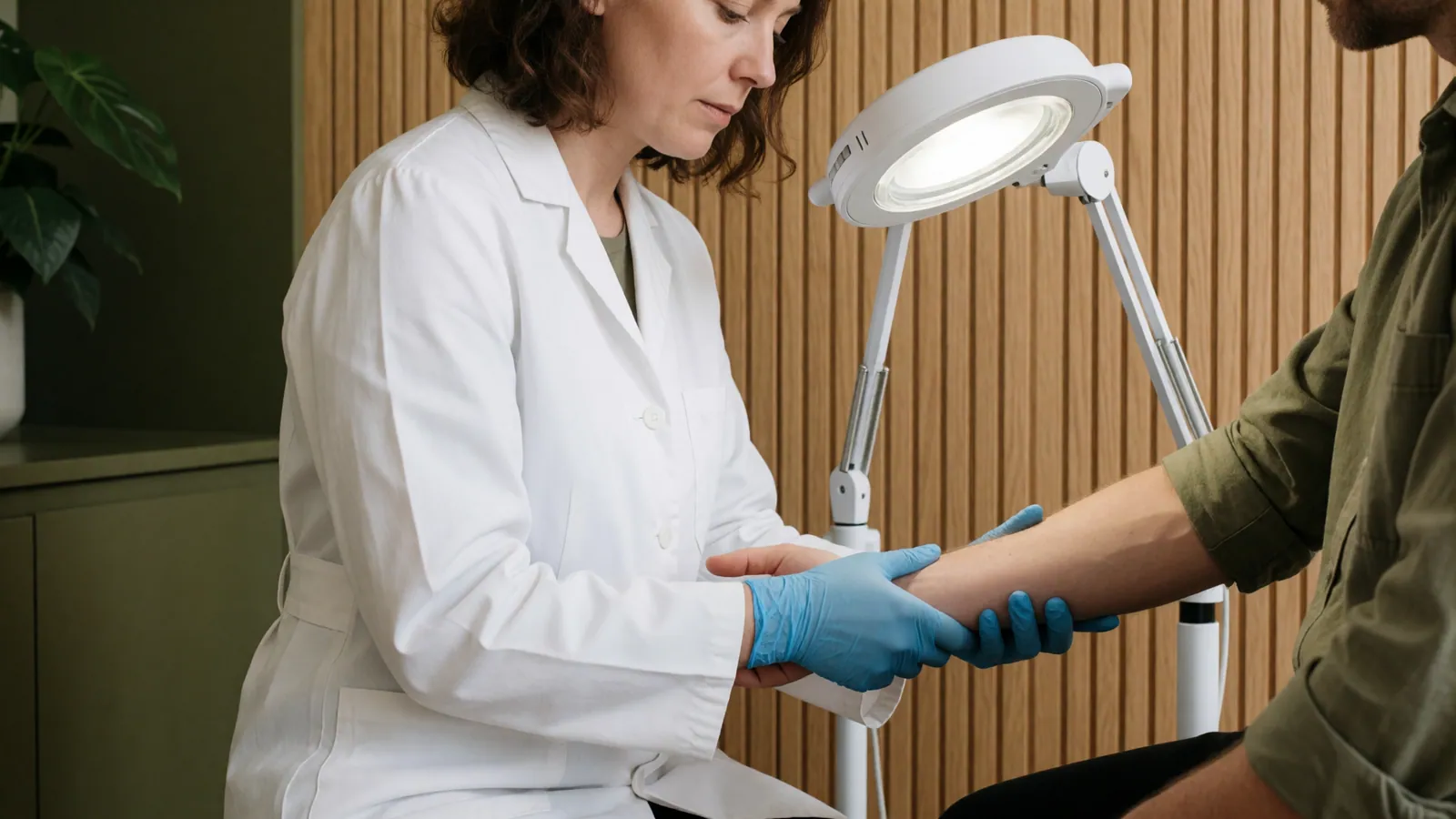
Some things should not wait for the next free routine appointment. Some things should not wait for the next free routine appointment. Telephone the practice and say what is happening, or go to an emergency room, if you have a mole or a mark that has changed shape, colour or size, that has become raised or uneven, or that bleeds, itches or will not heal; a sore anywhere that has not healed in three weeks; a rash that is spreading quickly, especially with fever, blistering, or peeling skin; a painful rash in a band on one side of the body, particularly near an eye; redness that is hot, swollen, tender and spreading, which can be a deep skin infection; a new rash after starting a medicine, especially with mouth or eye involvement; or a child under three months with any widespread rash. If you have been treated here and something is worse rather than better after a procedure, telephone us rather than waiting for the review appointment. We would far rather field a call that turns out to be nothing.
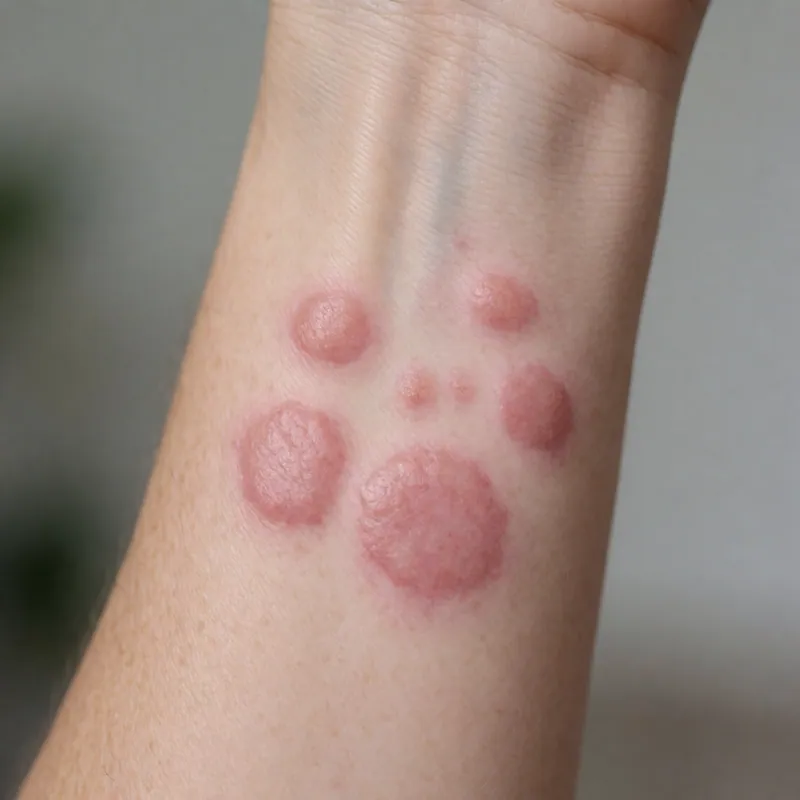
Urticaria is the medical term for hives: raised, itchy, pale-centred weals that appear on any part of the body, last from minutes to hours, and resolve without leaving a mark. The defining feature is that each individual weal comes and goes within a day, even though new ones keep appearing — a rash that stays put in the same place for days is something else and needs a different assessment. About forty per cent of people also get deeper swelling of the lips, eyelids or hands.
The single most useful thing to know is the difference between acute and chronic. Acute urticaria lasts under six weeks and is often triggered by a viral infection, occasionally by a medicine, and sometimes by a genuine allergy. Chronic urticaria — daily or near-daily weals for more than six weeks — is a different proposition, and in the great majority of cases there is no external trigger to find. It is usually spontaneous, frequently driven by the immune system acting against the person's own mast cells, and the search for a food cause is the single largest waste of effort in this condition.
The good news is that it is very treatable. Most chronic urticaria is controlled by non-sedating antihistamines, and the key point is the dose: guidelines support increasing up to four times the standard packet dose under medical supervision, which is where most under-treatment comes from. Most cases eventually resolve on their own, though that can take months to years, and knowing that it does usually end matters to people living through it.
Treating it properly
The ladder, in the order it is actually climbed.
A non-sedating antihistamine, daily, not as needed
Taken every day to prevent weals rather than in response to them. Continuous use is more effective than intermittent, and people who take one only when hives appear are consistently worse controlled.
Increasing the dose, under supervision
Up to four times the standard dose is a recognised approach for chronic urticaria and is where most people who believe antihistamines do not work for them actually get relief. Do this with us rather than on your own, and note that the sedating older antihistamines are not the right tool for daily control.
Adding a second agent
Other classes of medicine that act on different receptors are sometimes added where a single antihistamine at increased dose is not enough.
A short course of oral steroids for a severe flare only
Effective for a few days in a bad flare. Not a treatment for chronic urticaria — long-term or repeated steroid use for this is a well-recognised path to harm and is avoided.
Injectable targeted treatment for resistant chronic disease
There is an established injectable option for chronic urticaria that has not responded to antihistamines at increased dose, given monthly, and it works well for many people. It requires authorisation and monitoring, and it is not named here.
Identify and stop physical triggers where they exist
Some urticaria is reliably provoked by a physical stimulus — pressure, cold, heat, vibration, water, sunlight, or exercise. That subset is worth identifying because avoidance genuinely helps, and because cold-induced urticaria in particular has a specific hazard: swimming in cold water can cause a whole-body reaction.
Testing — what is worth doing and what is not
This is where most time and money are wasted in this condition.
Extensive allergy testing is usually not indicated
In chronic spontaneous urticaria there is generally no external allergen to find, and broad testing produces incidental positives that lead to needless food restriction. If your hives appear daily regardless of what you eat, a food is not causing them — an allergy severe enough to cause daily hives would produce a reaction within minutes of a specific food, every time.
A focused history beats a broad panel
What is worth doing is looking carefully at medicines, at recent infections, at physical triggers and at the timing. That history is more productive than any panel.
Basic blood tests, sometimes
A limited set, chiefly to look for an associated thyroid or inflammatory condition. Not an extensive screen — in the absence of other symptoms, a broad hunt in chronic urticaria has a very low yield.
A biopsy, where each weal lasts more than a day
If individual lesions persist beyond twenty-four hours, are painful rather than itchy, or leave bruising or staining behind, that is not ordinary urticaria and needs a biopsy to look for inflammation of the small blood vessels instead.
Keeping a diary is worth two weeks and not six months
Long enough to identify a physical trigger or a pattern. Beyond that it becomes a way of maintaining the belief that a hidden cause exists, and it makes people miserable.
When it is an emergency
Hives themselves are not dangerous. These accompanying features are.
Difficulty breathing, wheeze or throat tightness
Call emergency services. Hives with any airway symptom is a potential anaphylactic reaction and is treated as one until proven otherwise.
Swelling of the tongue, throat or the floor of the mouth
Emergency care. Swelling of lips and eyelids alone is common and much less alarming, but anything affecting the mouth or throat is urgent.
Faintness, collapse or a sudden drop in blood pressure
Along with widespread hives, this is anaphylaxis. Emergency services, not an appointment.
Hives with vomiting or abdominal pain shortly after a food or a sting
A pattern that suggests a genuine immediate allergy, which is a different condition from chronic urticaria and needs allergy assessment and possibly an adrenaline auto-injector.
Fever, joint pain, or weals that bruise and last for days
Suggests a different diagnosis involving inflammation of blood vessels, and warrants a prompt appointment and a biopsy rather than more antihistamines.
Hives & Urticaria in western Queens
Itchy weals that come up and go down within a day, moving around the body. Usually not an allergy, usually not caused by food, and usually controlled well by antihistamines at the right dose — which is often higher than the packet says.
Every appointment here starts the same way: a proper history, an examination in good light, and a named diagnosis said out loud and written down for you to take home. If there is genuine doubt you will be told that, and told what would settle it — usually a biopsy. You leave with a plan that has a strength, a site, a frequency and a date to stop or come back on it, and, where the condition is one that relapses, what to do on the first day of the next flare. If the honest answer is that this is better left alone, or that it belongs somewhere other than here, that is what you get instead, and it costs exactly the same.

This page is not medical advice, and it is not a diagnosis. Nothing on this website is medical advice for you in particular, and it is not a diagnosis. These pages describe conditions in general terms so that you arrive knowing what the questions are — they cannot tell you which condition you have, because that requires somebody to look at your skin, feel it, ask you a hundred questions and frequently take a sample of it. Two conditions on this website can look identical in a photograph and need opposite treatments. If something on your skin is new, changing, painful or not healing, the useful next step is an appointment rather than more reading.
No before-and-after photographs, and no promised outcome. There are no before-and-after photographs on this website and there never will be. Every set you have seen somewhere else was chosen from a much larger pile, and the second picture is usually taken in different light, at a different angle, at a different point in a flare cycle. In dermatology the dishonesty is sharper than in most fields, because nearly every condition here fluctuates on its own — photograph any relapsing skin disease at its worst and again at its best and you have a persuasive pair of images that demonstrates nothing about the treatment in between. What we publish instead is what a treatment typically achieves, in how long, in what proportion of people, and how often it does not work.
The risks, plainly. Every treatment described here has side effects, and some carry real risks. Topical steroids thin skin if they are used at the wrong strength on the wrong site for too long, which is why they are prescribed with a site, a strength and a stopping point rather than handed over indefinitely. Light-based and laser treatment can burn, blister and cause pigment change that lasts months, and that risk is higher on deeper skin tones and on recently tanned skin. Any procedure that breaks the skin can bleed, become infected and leave a scar; on the chest, the shoulders and the jawline, scars are more likely to thicken. Several of the medicines used in this speciality require blood tests, and some cannot be taken during pregnancy. We tell you your own risk rather than the average one, and where the honest answer is that a condition is better left alone, that is the advice you will get.
Nothing is diagnosed from a photograph. We do not diagnose skin from photographs, and we do not answer "what is this?" by email, by message or through a form. This is not caution for its own sake. A photograph has no history attached to it, cannot be felt, cannot be stretched or pressed to see whether the colour blanches, cannot be examined under a dermatoscope, and misreports colour badly — which matters enormously on skin that is not pale. The examination that actually distinguishes a harmless growth from an early cancer involves magnification, cross-polarised light and, when there is any doubt at all, a biopsy. An application that offers to tell you whether a mole is dangerous from a picture taken on a telephone is selling reassurance, and reassurance is the one product in this field that is dangerous when it is wrong. Bring the mark to a room where somebody can look at it.
Questions
Hives & Urticaria — the questions we are asked most
Is this an allergy to something I ate?
Almost certainly not, if you have had it for more than six weeks. Chronic urticaria is usually spontaneous, with no external trigger, and frequently driven by the immune system acting against the person's own cells. A food allergy severe enough to cause daily hives would cause a reaction within minutes of that specific food every single time — which is not the pattern people describe.
Should I have allergy testing?
Usually not for chronic hives. Broad testing produces incidental positives that lead to unnecessary food restriction and prolong the search. Where there is a clear history of an immediate reaction to a specific food or a sting, that is different and does warrant assessment.
The antihistamine is not working. What now?
Take it daily rather than when hives appear, and then talk to us about the dose — up to four times the standard packet dose is a recognised approach under supervision, and that is where most people who believe antihistamines do not work for them get relief. If that is still not enough there are further options, including an effective monthly injectable treatment.
How long will this last?
Most chronic urticaria resolves on its own, but the timescale is months to years rather than weeks. That is genuinely unsatisfying to hear and it is the truth. In the meantime it is highly controllable, which is the part worth acting on.
When is it an emergency?
Any difficulty breathing, wheeze, throat tightness, swelling of the tongue or throat, faintness or collapse means emergency services immediately. Hives alone, and swelling of lips or eyelids alone, are not emergencies — it is the airway and the blood pressure that matter.
My hives leave bruises and last for days. Is that normal?
No, and it changes the diagnosis. Ordinary urticarial weals resolve within twenty-four hours without a mark. Lesions that persist longer, hurt or burn rather than itch, or leave bruising suggest inflammation of the small blood vessels, and that needs an appointment and a biopsy rather than a higher dose of antihistamine.
Related
Often seen alongside this

Inflammatory Skin Disease
Acne
The commonest reason anybody sees a dermatologist. It is treatable in almost everybody, it takes about three months before you can judge whether a treatment worked, and treating it properly is how you avoid the scars.
Read more
Inflammatory Skin Disease
Eczema & Dermatitis
Itchy, inflamed, dry skin that flares and settles. It is controlled rather than cured, most of it is under-treated rather than over-treated, and the plan you leave with should include what to do on the first day of the next flare.
Read more
Inflammatory Skin Disease
Psoriasis
An immune-driven condition, not a skin infection and not contagious. Treatment ranges from creams through light therapy to targeted injections, and what has become achievable for severe psoriasis in the last decade is genuinely different from what came before.
Read moreA named diagnosis and a written plan you leave holding
Book an appointment
Pick a physician and a time from the calendar — it shows only the hours each of them genuinely has free. A new patient appointment is thirty minutes, a full skin examination forty-five, and you leave with a named diagnosis written down. If something on your skin has changed, telephone instead and say that word: it is triaged differently.