Room by room
Six spaces, each doing one job properly
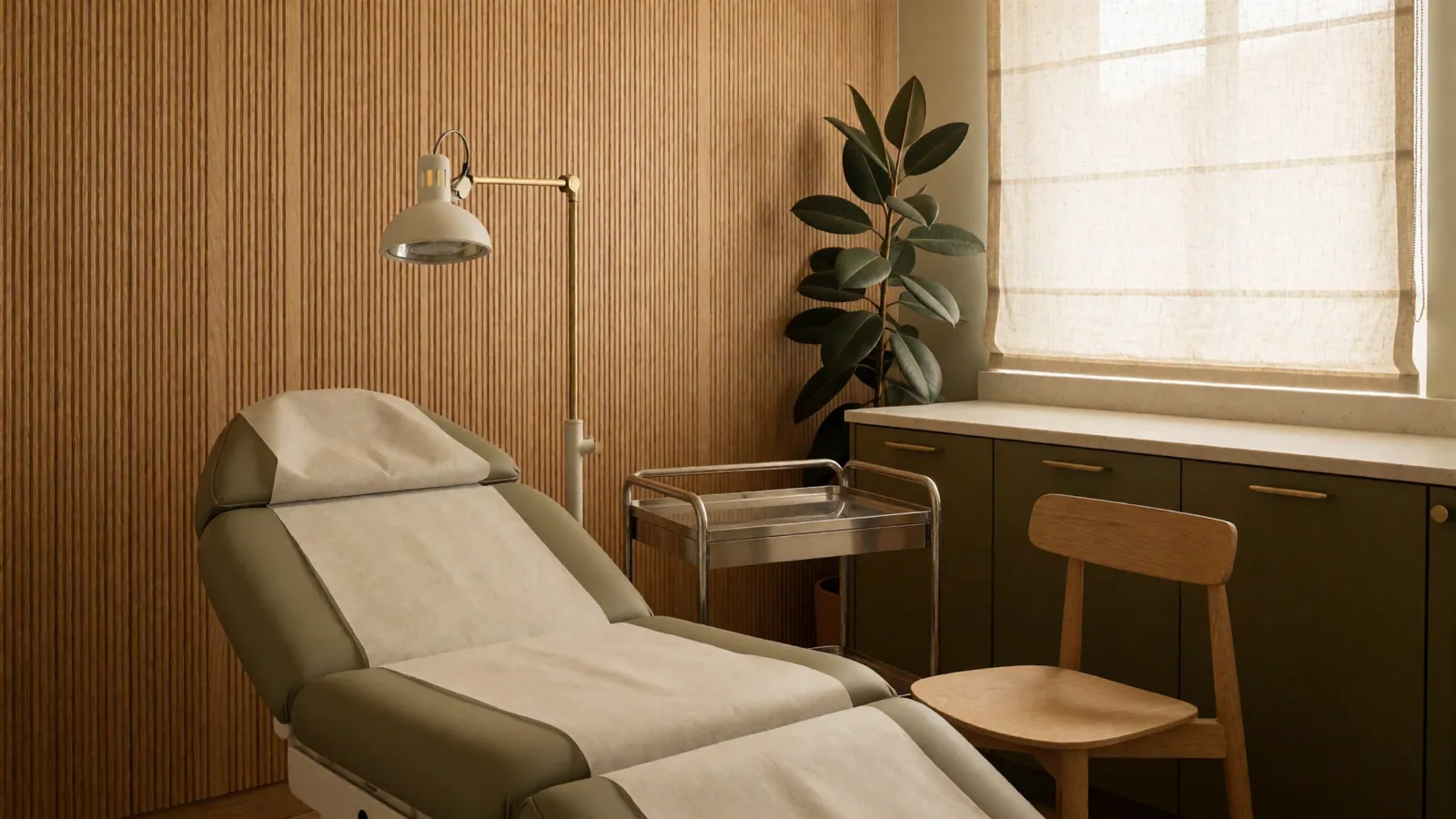
Four examination rooms, each with a door
One per clinician, each with its own examination couch, its own light and its own dermatoscope. Nobody is examined behind a curtain and nobody waits in a gown for a room to free up. Each room has a chair for somebody who came with you, because a fair number of appointments here involve news.
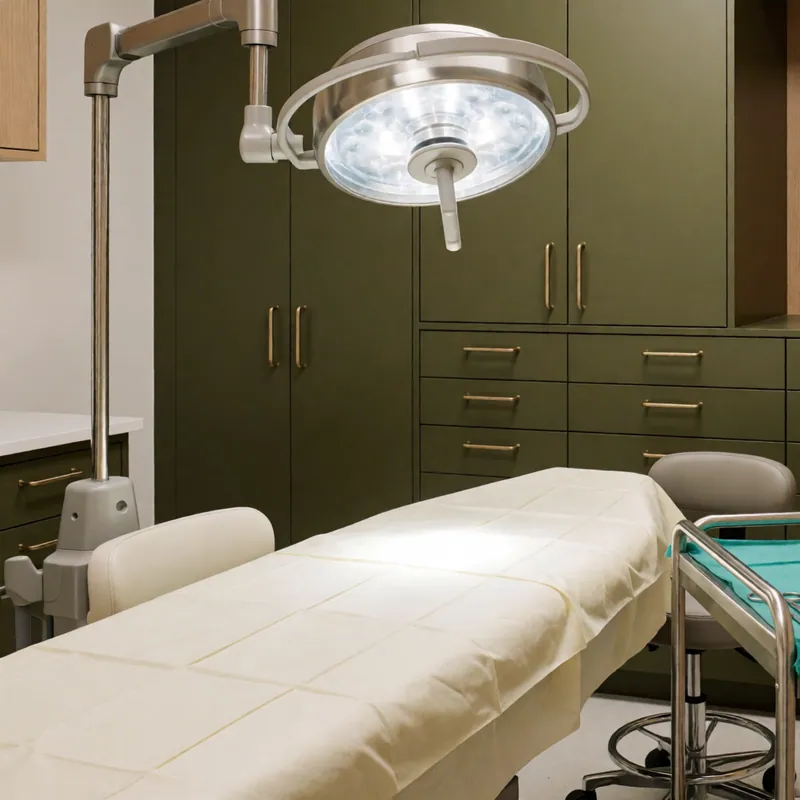
The minor-procedure room
Set up for surgery under local anaesthetic: a proper table, a surgical light, sterile trays and the electrosurgery unit. Biopsies, excisions, cyst removals and anything sutured happen here rather than in the examination room, which is a meaningful difference for infection risk and a large one for how the appointment feels.
The phototherapy booth, in a room of its own
A cabinet of narrowband ultraviolet tubes, used two or three times a week across a course of months for psoriasis, widespread eczema and vitiligo. It has its own room, its own door and its own eyewear station, because ultraviolet treatment is the part of this practice most capable of burning somebody and it is dosed in seconds.
The patch-testing bay
A bench, good light and the space to apply and read a full series of allergen panels across three visits in a week. Patch testing is unglamorous, slow and the only way to find out what somebody is genuinely allergic to, and it is the appointment that ends the most long-running dermatitis in this building.
The sample bench
Where nail clippings and skin scrapings are prepared and examined for fungus, so that an antifungal is prescribed because a fungus was seen rather than because a nail looked like one. Roughly half of thickened nails sent for testing are not fungal, and treating those with a course of antifungal tablets is months of medicine and blood tests for nothing.
A waiting room with enough chairs
Including a low table and a corner for children, spaced so that somebody with a visible skin condition is not sitting knee to knee with a stranger. A small thing, and the one patients mention most often.
No manufacturer is named here or anywhere on this site. We have deliberately not named a single manufacturer anywhere on this page, or anywhere on this website. Device and drug brands get named on medical websites to borrow authority from them and to make you shop for a machine or a molecule rather than for the person deciding whether you need it. The equipment here is ordinary professional kit that any dermatology practice can buy; the diagnosis matters more than the instrument, and the person making the diagnosis matters most. Ask us in the room and we will tell you exactly what we are using and why.
Getting here
Three minutes' walk from the 61st Street–Woodside station — the 7 train, the Long Island Rail Road, and the Q32, Q60, Q66 and Q70 buses all stop within a block. There is metered parking on 61st Street and a short loading bay outside the door. The entrance is step-free, every examination room is on one level, and the procedure room takes a wheelchair with the door closed.
- 37-32 61st Street
Woodside, NY 11377 - Monday – Thursday — 8:00 am – 6:00 pm
Friday — 8:00 am – 4:00 pm
Saturday — 9:00 am – 2:00 pm
Sunday — Closed - 000-000-0000
Questions
The practice — the questions we are asked most
Is the practice accessible?
The entrance is step-free, every examination room is on one level, and the procedure room takes a wheelchair with the door closed. If there is something specific you need, telephone before you come and we will arrange it rather than improvising on the day. See /accessibility.html.
Is there parking?
Metered parking on 61st Street and a short loading bay outside the door. Most patients come by the 7 train — the 61st Street–Woodside station is three minutes' walk, and the Long Island Rail Road stops there too.
Can somebody come in with me?
Yes. Every examination room has a chair for somebody who came with you, which is deliberate: a fair number of appointments here involve news, and people remember about half of what is said. A chaperone for an examination is also available on request and is entirely ordinary.
Why does the phototherapy booth have its own room?
Because ultraviolet treatment is the part of this practice most capable of burning somebody, it is dosed in seconds, and it needs its own door, its own eyewear station and no possibility of somebody walking in. It is the same reasoning that keeps surgery out of the examination rooms.
A named diagnosis and a written plan you leave holding
Book an appointment
Pick a physician and a time from the calendar — it shows only the hours each of them genuinely has free. A new patient appointment is thirty minutes, a full skin examination forty-five, and you leave with a named diagnosis written down. If something on your skin has changed, telephone instead and say that word: it is triaged differently.