
Some things should not wait for the next free routine appointment. Some things should not wait for the next free routine appointment. Telephone the practice and say what is happening, or go to an emergency room, if you have a mole or a mark that has changed shape, colour or size, that has become raised or uneven, or that bleeds, itches or will not heal; a sore anywhere that has not healed in three weeks; a rash that is spreading quickly, especially with fever, blistering, or peeling skin; a painful rash in a band on one side of the body, particularly near an eye; redness that is hot, swollen, tender and spreading, which can be a deep skin infection; a new rash after starting a medicine, especially with mouth or eye involvement; or a child under three months with any widespread rash. If you have been treated here and something is worse rather than better after a procedure, telephone us rather than waiting for the review appointment. We would far rather field a call that turns out to be nothing.
In psoriasis the immune system drives skin cells to be produced far faster than they can be shed, which builds the thickened, scaly, well-defined plaques that characterise it — most often on elbows, knees, the scalp and the lower back, though it appears in the folds, on the palms and soles, and in the nails. It is not an infection, it is not contagious, and it is not caused by poor hygiene, which patients are asked about often enough that it is worth stating first.
The most important thing that gets missed is that psoriasis is not confined to skin. Up to about a third of people with it develop an associated inflammatory arthritis, and that joint damage can be permanent if it is not treated early — so we ask every patient here about joint pain and morning stiffness at every appointment, and refer when the answer suggests it. It also travels with a raised risk of cardiovascular and metabolic disease, which makes blood pressure, cholesterol and glucose part of your care rather than somebody else's problem.
Severity is not measured by how much skin is involved. A small amount on the palms, the soles or the genitals can be far more disabling than extensive plaques on a back, and psoriasis that is visible on the hands, face or scalp carries a social weight that a body surface percentage does not capture. Treatment here is decided on what it is doing to your life as much as on what it covers.
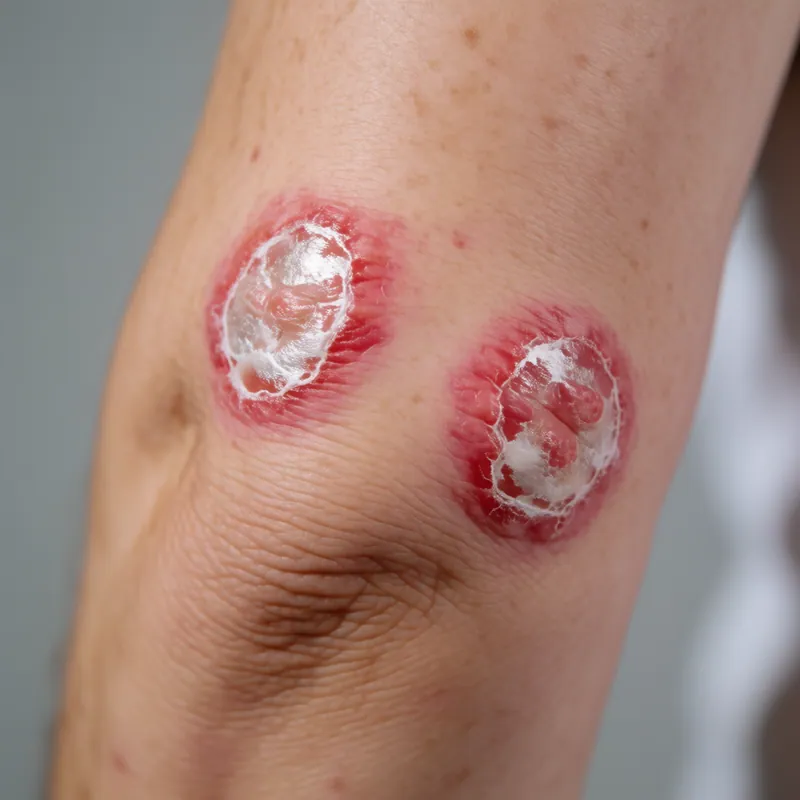
Treatment, from the top
Escalation is based on severity, on site, and on how much the condition is affecting you.
Topical treatment, for limited disease
A combination of a topical steroid and a vitamin D analogue is the usual foundation — the steroid reduces inflammation, the vitamin D analogue slows the excessive cell turnover, and together they work better than either alone. Coal tar preparations still have a genuine role, particularly for the scalp, and are unfashionable mainly because of the smell. Thick scale needs softening before anything can penetrate it, which is why a scale-lifting preparation is often step one.
Scalp psoriasis, which needs its own plan
The commonest site and the hardest to treat, because hair gets in the way and ordinary creams are unusable. Solutions, gels, foams and overnight oils exist for exactly this. Thick scale is lifted first; treating on top of it achieves very little.
Phototherapy, for widespread plaque disease
Narrowband ultraviolet light, two or three times a week for a course of months, in a booth in this building. Genuinely effective, avoids systemic medication entirely, and its cost is the number of visits — a course is dozens of them. Cumulative lifetime dose is recorded, because ultraviolet exposure carries long-term risk of its own. See /phototherapy.html.
Systemic tablets
Older immune-modulating medicines that work well for many people and require regular blood tests. Some cannot be taken during pregnancy and some interact substantially with alcohol, which is a conversation worth having honestly rather than a box to tick.
Targeted injectable treatments, for moderate to severe disease
These block the specific immune signals that drive psoriasis, rather than suppressing immunity broadly, and for many people they achieve a degree of control that older treatments did not. They are given by injection at intervals from fortnightly to quarterly, they require screening beforehand — including for tuberculosis and hepatitis — and monitoring afterwards, and they carry an increased infection risk. They are also expensive and generally need insurance authorisation. None is named on this website; that discussion belongs in the room with your history in front of us.
Treating what triggers a flare
Streptococcal throat infection can trigger the small-spot form, particularly in younger patients; certain medicines provoke psoriasis; skin injury produces plaques along the line of the injury; and smoking and heavy alcohol use both worsen it and reduce how well treatment works. Stress is a real trigger and not an imagined one.
The parts of psoriasis that are not skin
Why this appointment asks about your joints, your blood pressure and your mood.
Joints — ask about this every time
Pain and stiffness in the fingers, toes, lower back or heels, worse in the morning and better with movement, or a whole finger or toe swollen rather than a single joint. Psoriatic arthritis can cause permanent joint damage, early treatment changes that, and the skin disease usually appears first — which puts dermatology in the position of catching it. Tell us even if it seems unrelated.
Nails
Pitting, thickening, crumbling or lifting of the nail from its bed. Nail involvement is common, it is frequently mistaken for a fungal infection and treated as one for years, and it is associated with a higher likelihood of joint involvement — which makes it worth mentioning specifically.
Cardiovascular and metabolic risk
Psoriasis, particularly severe psoriasis, is associated with a raised risk of heart disease, high blood pressure, diabetes and fatty liver. That is a reason to have those checked regularly rather than a reason to worry, and controlling the inflammation is part of the argument for treating severe disease properly.
Mood
Rates of depression and anxiety are meaningfully higher in people with psoriasis, and the relationship runs in both directions. It is a normal thing to raise in this room and it changes what we recommend — a condition that is objectively mild and is stopping you swimming, dating or wearing short sleeves is not being treated adequately.
Psoriasis in western Queens
An immune-driven condition, not a skin infection and not contagious. Treatment ranges from creams through light therapy to targeted injections, and what has become achievable for severe psoriasis in the last decade is genuinely different from what came before.
Every appointment here starts the same way: a proper history, an examination in good light, and a named diagnosis said out loud and written down for you to take home. If there is genuine doubt you will be told that, and told what would settle it — usually a biopsy. You leave with a plan that has a strength, a site, a frequency and a date to stop or come back on it, and, where the condition is one that relapses, what to do on the first day of the next flare. If the honest answer is that this is better left alone, or that it belongs somewhere other than here, that is what you get instead, and it costs exactly the same.

This page is not medical advice, and it is not a diagnosis. Nothing on this website is medical advice for you in particular, and it is not a diagnosis. These pages describe conditions in general terms so that you arrive knowing what the questions are — they cannot tell you which condition you have, because that requires somebody to look at your skin, feel it, ask you a hundred questions and frequently take a sample of it. Two conditions on this website can look identical in a photograph and need opposite treatments. If something on your skin is new, changing, painful or not healing, the useful next step is an appointment rather than more reading.
No before-and-after photographs, and no promised outcome. There are no before-and-after photographs on this website and there never will be. Every set you have seen somewhere else was chosen from a much larger pile, and the second picture is usually taken in different light, at a different angle, at a different point in a flare cycle. In dermatology the dishonesty is sharper than in most fields, because nearly every condition here fluctuates on its own — photograph any relapsing skin disease at its worst and again at its best and you have a persuasive pair of images that demonstrates nothing about the treatment in between. What we publish instead is what a treatment typically achieves, in how long, in what proportion of people, and how often it does not work.
The risks, plainly. Every treatment described here has side effects, and some carry real risks. Topical steroids thin skin if they are used at the wrong strength on the wrong site for too long, which is why they are prescribed with a site, a strength and a stopping point rather than handed over indefinitely. Light-based and laser treatment can burn, blister and cause pigment change that lasts months, and that risk is higher on deeper skin tones and on recently tanned skin. Any procedure that breaks the skin can bleed, become infected and leave a scar; on the chest, the shoulders and the jawline, scars are more likely to thicken. Several of the medicines used in this speciality require blood tests, and some cannot be taken during pregnancy. We tell you your own risk rather than the average one, and where the honest answer is that a condition is better left alone, that is the advice you will get.
Nothing is diagnosed from a photograph. We do not diagnose skin from photographs, and we do not answer "what is this?" by email, by message or through a form. This is not caution for its own sake. A photograph has no history attached to it, cannot be felt, cannot be stretched or pressed to see whether the colour blanches, cannot be examined under a dermatoscope, and misreports colour badly — which matters enormously on skin that is not pale. The examination that actually distinguishes a harmless growth from an early cancer involves magnification, cross-polarised light and, when there is any doubt at all, a biopsy. An application that offers to tell you whether a mole is dangerous from a picture taken on a telephone is selling reassurance, and reassurance is the one product in this field that is dangerous when it is wrong. Bring the mark to a room where somebody can look at it.
Questions
Psoriasis — the questions we are asked most
Is psoriasis contagious?
No. It cannot be caught or passed on by any kind of contact. It is an immune-driven condition, it frequently runs in families, and it was not caused by anything you did or failed to wash. This gets asked often enough — usually by somebody who has been made to feel awkward at a pool or a barber's — that it belongs at the top of the page.
Can it be cured?
No, and treatment aims at control instead. It is a long-term condition that relapses, and the honest measure of success is how much of your year you spend comfortable and how quickly a flare is handled. What has changed in the last decade is the degree of control achievable in severe disease, which for many people is genuinely different from what was possible before.
Why do you keep asking about my joints?
Because up to about a third of people with psoriasis develop an associated arthritis, that arthritis can cause permanent damage if it is not treated early, and the skin disease usually appears first. Dermatology is therefore where it gets caught. Morning stiffness, painful heels, or a whole finger or toe swollen rather than one joint are the things to report.
Does sunlight help?
Natural sunlight improves psoriasis in most people, which is the principle phototherapy is built on. That is not a recommendation to sunbathe or to use a sunbed: burning triggers new plaques through skin injury, and the cancer risk is real. Controlled narrowband treatment delivers the benefit at a measured dose with the exposure recorded.
Are the injectable treatments dangerous?
They carry an increased infection risk, they require screening beforehand — including for tuberculosis and hepatitis — and they require monitoring afterwards. Against that, untreated severe psoriasis carries its own risks, including to the joints and to cardiovascular health. It is a real decision with real trade-offs on both sides, and it is made with your history in front of us rather than from a page.
My nails are thick and crumbling. Is that fungus?
It may be, and in somebody with psoriasis it is at least as likely to be the psoriasis. The two are routinely confused and the treatments are entirely different, which is why we sample nails rather than assume. Months of antifungal tablets with blood tests for a nail that was never fungal is a common and avoidable outcome.
Will losing weight or drinking less actually make a difference?
Both genuinely do — heavy alcohol use and obesity both worsen psoriasis and reduce how well treatment works, and smoking is strongly associated with the palm and sole form in particular. That is offered as something within your control, not as a suggestion that you caused this.
Related
Often seen alongside this

Inflammatory Skin Disease
Acne
The commonest reason anybody sees a dermatologist. It is treatable in almost everybody, it takes about three months before you can judge whether a treatment worked, and treating it properly is how you avoid the scars.
Read more
Inflammatory Skin Disease
Eczema & Dermatitis
Itchy, inflamed, dry skin that flares and settles. It is controlled rather than cured, most of it is under-treated rather than over-treated, and the plan you leave with should include what to do on the first day of the next flare.
Read more
Inflammatory Skin Disease
Rosacea
Persistent central facial redness, flushing, visible vessels and inflammatory bumps. It is not acne, it is not caused by drinking, and the single most effective thing most people do for it is daily sun protection.
Read moreA named diagnosis and a written plan you leave holding
Book an appointment
Pick a physician and a time from the calendar — it shows only the hours each of them genuinely has free. A new patient appointment is thirty minutes, a full skin examination forty-five, and you leave with a named diagnosis written down. If something on your skin has changed, telephone instead and say that word: it is triaged differently.