Some things should not wait for the next free routine appointment. Some things should not wait for the next free routine appointment. Telephone the practice and say what is happening, or go to an emergency room, if you have a mole or a mark that has changed shape, colour or size, that has become raised or uneven, or that bleeds, itches or will not heal; a sore anywhere that has not healed in three weeks; a rash that is spreading quickly, especially with fever, blistering, or peeling skin; a painful rash in a band on one side of the body, particularly near an eye; redness that is hot, swollen, tender and spreading, which can be a deep skin infection; a new rash after starting a medicine, especially with mouth or eye involvement; or a child under three months with any widespread rash. If you have been treated here and something is worse rather than better after a procedure, telephone us rather than waiting for the review appointment. We would far rather field a call that turns out to be nothing.
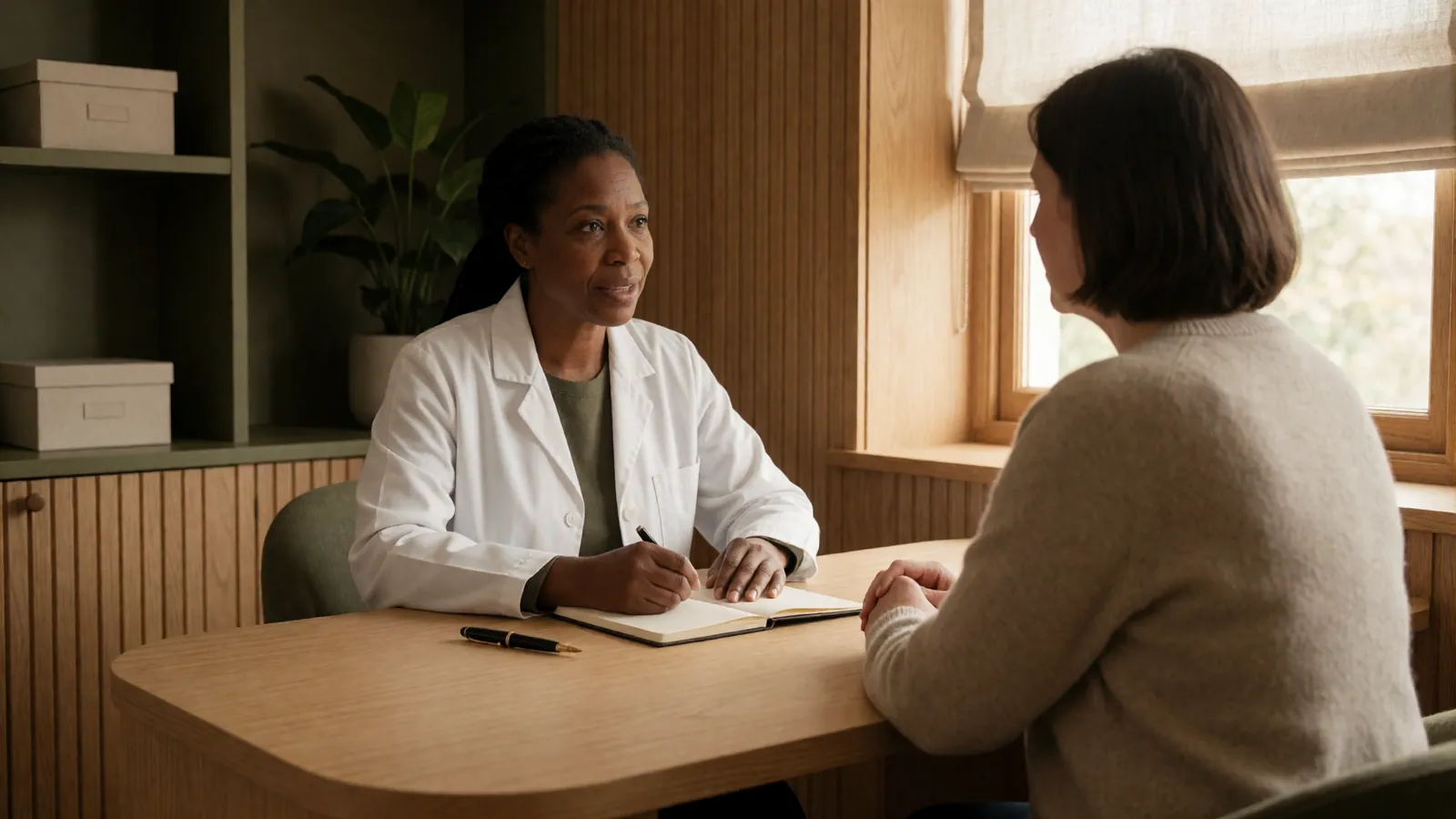
Most people arriving for a first dermatology appointment expect somebody to glance at the spot they are worried about and pronounce on it. The glancing is real and it is the smaller half of what happens.
The larger half is questions. When did it start, where did it start first, what did it look like then, what makes it better or worse, does it itch or hurt, what have you already put on it and what happened, what else has changed about you, what do you take, what runs in your family, and what do you handle all day. A surprising number of long-running rashes are solved by the question about work, and a surprising number more by reading the strength off a tube somebody brought in.
Then the examination — and for a new patient that means all of your skin unless you ask otherwise. Scalp, behind the ears, the back, between the toes, the soles and the nails. A great many of the cancers found in this building were found somewhere the patient could not see and had not mentioned. If you would rather only the one spot were looked at, say so and that is what we will do, and we will ask once more before you leave.

Practical
What to bring, how to arrive, and what it costs
Bring
A list of every medicine you take, including anything bought over a counter and anything for another condition; the actual tubes and bottles of whatever you have been putting on your skin, because the strength on the label matters and nobody remembers it; and any biopsy report or letter from a previous practice.
Arrive
Ten minutes early the first time. There is a history form to complete, and doing it in the waiting room with a pen beats doing it in the examination room with the clock running.
Expect
Thirty minutes for a new patient, forty-five for a full skin check, an hour for a child or for patch testing. You will be asked to change into a gown for a full examination — the practice is set up so that this happens with the door closed and a chaperone available if you would like one, and you only have to ask.
Wear
Something easy to take off, and please come with the skin you actually live with: no makeup if you can manage it, no fresh nail polish if the appointment concerns your nails, and no fake tan in the fortnight before a skin check, because it hides exactly what the examination is looking for.
Afterwards
You leave holding a written diagnosis and a written plan. If a sample was taken you leave knowing when and how you will get the result, and you are telephoned either way rather than only if there is bad news.
Cost
$185 for a new patient consultation and $225 for a full skin examination if you are paying for yourself. Most medical dermatology is covered by insurance; you will be told which side of the medical and cosmetic line your visit falls on before it begins.
The whole appointment
From the booking to the written plan
Six stages. The second is where most of the diagnosis is made, and the sixth is the one most often missing from care people have had elsewhere.
The booking
You pick a physician and a time from the calendar on /appointments.html, or you telephone and we do it for you. The calendar shows only hours that are genuinely free — it is reading the same schedule the physician keeps, so an hour on screen is an hour you can have. If something has changed on your skin, say the word changed when you telephone: that is triaged differently from a routine appointment.
The history, which is most of the diagnosis
When it started, where it started, what it looked like then, what makes it worse, what you have already put on it and what happened. Then the rest of you: your general health, your medicines, what runs in your family, your work and what you handle all day. A surprising number of rashes are solved by the question about work.
The examination, in good light, in a gown
For a new patient that means the whole skin unless you ask otherwise — scalp, behind the ears, the back, between the toes, the soles and the nails. Anything of interest is examined again through a dermatoscope, which is a magnifier with cross-polarised light that shows structures under the surface you cannot see with the naked eye. You are welcome to look through it too, and most people do.
A name, out loud and written down
You are told what we think it is and why. If there is genuine doubt you are told that, and told what would resolve it — usually a biopsy, sometimes a swab, occasionally simply waiting a fortnight and looking again. Uncertainty stated plainly is better medicine than a confident guess.
A sample, if a sample is what settles it
A biopsy is done in the same appointment where possible, under local anaesthetic, in the procedure room. It takes about fifteen minutes, it stings for ten seconds while the anaesthetic goes in and then it does not hurt, and the result takes roughly a week. You will be told how you get the result before you leave — we telephone every result, including the reassuring ones.
The plan, on paper, with a stopping point
What to use, where, how much, how often, and when to stop or come back. Anything with a real risk attached carries its review date on the same sheet. If the condition is one that relapses, the plan includes what to do at the start of the next flare, so that the next flare is handled in two days rather than in three weeks of waiting for an appointment.
Afterwards
What you leave holding
A named diagnosis and a plan with a stopping point on it. You should be able to say what you have when you get home, spell it, and look it up.
- A named diagnosis, written down — or a plain statement that we are not sure, and what would settle it
- What to use, where, how much, how often, and the date to stop or come back
- The blood test already booked, if the treatment needs one
- A flare plan, if the condition is one that relapses — what to do on day one of the next one
- How and when you get any biopsy result, and the fact that we telephone either way
- An honest statement of what the treatment will not do, alongside what it will

Questions
First appointment — the questions we are asked most
How long is the first appointment?
Thirty minutes for a new patient, forty-five if you are booked for a full skin examination, and an hour for a child or for patch testing. Most of that time is history and examination rather than treatment, because in this speciality the history is where most of the diagnosis actually comes from.
Will I be treated at that appointment?
Frequently, yes. Unlike some specialities, dermatology often diagnoses and treats in the same visit, and where a biopsy is needed we would rather take it there and then than book you back. Some procedures are planned for a second visit because the technique has to be chosen deliberately — anything possibly a melanoma, for instance, is taken whole with a margin rather than improvised.
What should I bring?
A list of every medicine you take, including anything bought over a counter and anything for another condition. The actual tubes and bottles of whatever you have been putting on your skin — the strength on the label matters and nobody remembers it accurately. Any biopsy report or letter from a previous practice. And your insurance card if you are using one.
How should I turn up?
With the skin you actually live with. No makeup if you can manage it, because we assess in daylight; no fresh nail polish if the appointment concerns your nails or if you are having a full skin examination, because melanoma can arise under a nail and polish hides exactly that; and no fake tan in the fortnight before a skin examination, for the same reason.
Will I have to undress?
For a full skin examination, yes — into a gown, with the examination done in sections so that you are never fully uncovered, and underwear stays on. For a single spot, no. A chaperone is available at any examination and you only have to ask; it is an entirely ordinary request and nobody will ask why.
What does it cost?
$185 for a new patient consultation and $225 for a full skin examination if you are paying for yourself. Most medical dermatology is covered by insurance and most cosmetic dermatology is not, and you are told which side of that line your visit falls on before it begins. What we cannot tell you is what your plan will pay — telephone the number on your card and ask about your deductible.
Can somebody come in with me?
Yes, always, and every examination room has a chair for them. A fair number of appointments here involve news, and people remember about half of what is said in those. For anybody under eighteen a parent or guardian must be present for the whole appointment.
This page is not medical advice, and it is not a diagnosis. Nothing on this website is medical advice for you in particular, and it is not a diagnosis. These pages describe conditions in general terms so that you arrive knowing what the questions are — they cannot tell you which condition you have, because that requires somebody to look at your skin, feel it, ask you a hundred questions and frequently take a sample of it. Two conditions on this website can look identical in a photograph and need opposite treatments. If something on your skin is new, changing, painful or not healing, the useful next step is an appointment rather than more reading.
No before-and-after photographs, and no promised outcome. There are no before-and-after photographs on this website and there never will be. Every set you have seen somewhere else was chosen from a much larger pile, and the second picture is usually taken in different light, at a different angle, at a different point in a flare cycle. In dermatology the dishonesty is sharper than in most fields, because nearly every condition here fluctuates on its own — photograph any relapsing skin disease at its worst and again at its best and you have a persuasive pair of images that demonstrates nothing about the treatment in between. What we publish instead is what a treatment typically achieves, in how long, in what proportion of people, and how often it does not work.
A named diagnosis and a written plan you leave holding
Book an appointment
Pick a physician and a time from the calendar — it shows only the hours each of them genuinely has free. A new patient appointment is thirty minutes, a full skin examination forty-five, and you leave with a named diagnosis written down. If something on your skin has changed, telephone instead and say that word: it is triaged differently.