
Some things should not wait for the next free routine appointment. Some things should not wait for the next free routine appointment. Telephone the practice and say what is happening, or go to an emergency room, if you have a mole or a mark that has changed shape, colour or size, that has become raised or uneven, or that bleeds, itches or will not heal; a sore anywhere that has not healed in three weeks; a rash that is spreading quickly, especially with fever, blistering, or peeling skin; a painful rash in a band on one side of the body, particularly near an eye; redness that is hot, swollen, tender and spreading, which can be a deep skin infection; a new rash after starting a medicine, especially with mouth or eye involvement; or a child under three months with any widespread rash. If you have been treated here and something is worse rather than better after a procedure, telephone us rather than waiting for the review appointment. We would far rather field a call that turns out to be nothing.
Skin biology is the same everywhere; what differs is how much pigment is present, how it behaves when the skin is inflamed or injured, and how conditions look as a result. Those differences are not cosmetic footnotes. They change which diagnoses are missed, which treatments are safe, and which complaint the patient actually wants addressed — and a practice that has not thought about them will get all three wrong regularly while believing it is doing fine.
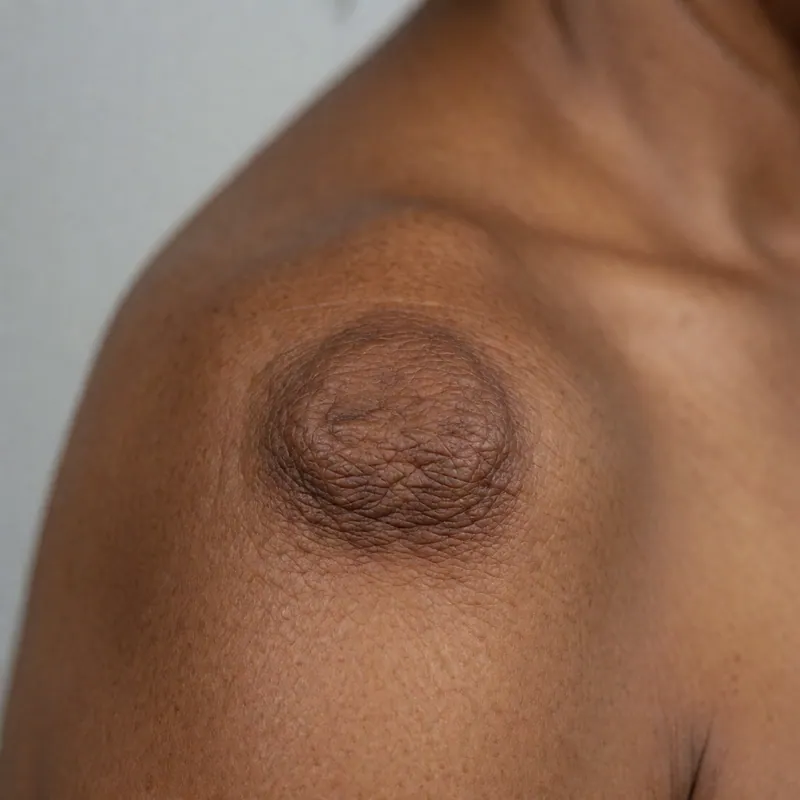
The most consequential difference is that redness does not read as red. Inflammation on deeply pigmented skin appears violet, grey, dark brown or simply as skin that is darker than its surroundings. Since clinicians are trained to look for erythema, and most of the photographs in the textbooks show it on pale skin, inflammatory disease on darker skin is routinely under-recognised and under-treated — eczema graded as mild when it is severe, cellulitis missed, a drug reaction not spotted. Examining by touch and by asking about symptoms, rather than by looking for pink, is the correction.
The second is that inflammation leaves pigment behind. Any condition that inflames the skin — acne, eczema, a bite, an ingrown hair — leaves marks that are more pronounced and far longer-lasting. Very often the mark, rather than the disease, is what the patient wants treated, and that is a reasonable position rather than a vanity to be redirected. It also changes the clinical calculation: controlling inflammation quickly matters more here, because every week of active disease produces marks that take a year to fade.
What is genuinely different
The practical differences that change diagnosis and treatment.
Inflammation does not look pink
It appears violet, grey or darker brown. Under-recognition of inflammatory disease follows directly, and it is why severity here is assessed by symptoms, by texture and by touch as much as by colour.
Pigment change is frequently the presenting complaint
And it should be treated as a legitimate clinical problem rather than as a cosmetic aside. It also changes the treatment plan: anything that irritates causes pigmentation, so gentle and slow beats aggressive and fast.
Keloid and hypertrophic scarring is more likely
Which changes the threshold for elective procedures, the technique used, the site chosen for a biopsy where there is a choice, and whether preventive measures are started immediately after a procedure rather than once a scar has thickened. It is discussed before any procedure here rather than afterwards.
Laser and light treatments carry different risk
Melanin absorbs the energy these devices deliver, so the risk of burns, blistering and long-lasting pigment change is meaningfully higher. Some devices are unsuitable; others need lower settings, longer intervals and test patches. The honest answer is sometimes that a light-based treatment is the wrong choice, and that answer is more useful than a cautious version of the wrong treatment.
Cryotherapy leaves pale marks that may be permanent
Pigment cells are more sensitive to cold than the surrounding tissue. On deeply pigmented skin the resulting pale spot can be permanent and obvious, which is a genuine reason to choose a different treatment for a harmless lesion.
Skin cancer is less common and diagnosed later
Which is what worsens outcomes rather than the biology. It also occurs in different places — the palms, the soles, the nail beds and the mouth — and those are the sites most often skipped in a hurried examination. They are examined here on everybody.
Conditions seen more often here
Not exclusive to any group, and disproportionately represented.
Ingrown hairs and razor bumps
Tightly curled hair re-entering the skin after shaving, producing inflamed bumps and, over time, keloid-like scarring on the beard area and the neck. Management is mostly technique — shaving less closely, in the direction of growth, with a single blade — plus treatment of the inflammation and sometimes long-term hair reduction.
Bumps at the back of the scalp and neck
Firm papules and, over time, keloid-like plaques at the hairline. Early treatment matters considerably, because the late stage is difficult to treat and permanent.
Central centrifugal cicatricial alopecia
A scarring hair loss beginning at the crown, occurring predominantly in Black women, frequently presenting late because early symptoms are subtle. Early diagnosis genuinely changes the outcome — see /hair-loss-treatment.html.
Traction alopecia
Entirely preventable and reversible early, permanent late. The conversation here is practical rather than moralising: finding a way to wear your hair that you like and that does not pull.
Melasma
More common and more stubborn on medium to deep skin tones, and driven by visible light as well as ultraviolet — see /melasma-treatment.html.
Sarcoidosis of the skin, and lupus
Both more common in Black patients, both can present first in the skin, and both are worth considering in an unexplained persistent eruption rather than treating it repeatedly as eczema.
How this practice actually handles it
Statements of intent are cheap. These are the things we actually do differently.
We ask what is bothering you most, and take that answer seriously
If the marks matter more to you than the acne, that shapes the plan. It is not redirected towards what a clinician would find more medically interesting.
We start conservatively with anything that irritates
Retinoids introduced twice weekly, peels started at the lowest useful strength, test patches before energy devices. Irritation is not a neutral cost here.
We discuss scarring risk before any elective procedure
Including whether a lesion needs removing at all, and where a biopsy is best sited when there is a choice.
We examine palms, soles, nails and the mouth on everybody
Because these are the sites where melanoma on pigmented skin most often appears and where it is most often found late.
We ask to see what you are actually using
Including anything bought abroad or online. Skin-lightening products sold outside regulated channels have been found to contain mercury or potent steroids, both of which cause real harm, and the steroid-containing ones produce a rebound darkening worse than the original problem. Bring the container rather than the name.
Skin of Color Dermatology in western Queens
Not a separate speciality — a set of things that are genuinely different and that this field's defaults were not built around. Redness reads differently, pigment change is the presenting complaint more often than the disease, and every light-based treatment carries different risk.
Every appointment here starts the same way: a proper history, an examination in good light, and a named diagnosis said out loud and written down for you to take home. If there is genuine doubt you will be told that, and told what would settle it — usually a biopsy. You leave with a plan that has a strength, a site, a frequency and a date to stop or come back on it, and, where the condition is one that relapses, what to do on the first day of the next flare. If the honest answer is that this is better left alone, or that it belongs somewhere other than here, that is what you get instead, and it costs exactly the same.

This page is not medical advice, and it is not a diagnosis. Nothing on this website is medical advice for you in particular, and it is not a diagnosis. These pages describe conditions in general terms so that you arrive knowing what the questions are — they cannot tell you which condition you have, because that requires somebody to look at your skin, feel it, ask you a hundred questions and frequently take a sample of it. Two conditions on this website can look identical in a photograph and need opposite treatments. If something on your skin is new, changing, painful or not healing, the useful next step is an appointment rather than more reading.
No before-and-after photographs, and no promised outcome. There are no before-and-after photographs on this website and there never will be. Every set you have seen somewhere else was chosen from a much larger pile, and the second picture is usually taken in different light, at a different angle, at a different point in a flare cycle. In dermatology the dishonesty is sharper than in most fields, because nearly every condition here fluctuates on its own — photograph any relapsing skin disease at its worst and again at its best and you have a persuasive pair of images that demonstrates nothing about the treatment in between. What we publish instead is what a treatment typically achieves, in how long, in what proportion of people, and how often it does not work.
The risks, plainly. Every treatment described here has side effects, and some carry real risks. Topical steroids thin skin if they are used at the wrong strength on the wrong site for too long, which is why they are prescribed with a site, a strength and a stopping point rather than handed over indefinitely. Light-based and laser treatment can burn, blister and cause pigment change that lasts months, and that risk is higher on deeper skin tones and on recently tanned skin. Any procedure that breaks the skin can bleed, become infected and leave a scar; on the chest, the shoulders and the jawline, scars are more likely to thicken. Several of the medicines used in this speciality require blood tests, and some cannot be taken during pregnancy. We tell you your own risk rather than the average one, and where the honest answer is that a condition is better left alone, that is the advice you will get.
Nothing is diagnosed from a photograph. We do not diagnose skin from photographs, and we do not answer "what is this?" by email, by message or through a form. This is not caution for its own sake. A photograph has no history attached to it, cannot be felt, cannot be stretched or pressed to see whether the colour blanches, cannot be examined under a dermatoscope, and misreports colour badly — which matters enormously on skin that is not pale. The examination that actually distinguishes a harmless growth from an early cancer involves magnification, cross-polarised light and, when there is any doubt at all, a biopsy. An application that offers to tell you whether a mole is dangerous from a picture taken on a telephone is selling reassurance, and reassurance is the one product in this field that is dangerous when it is wrong. Bring the mark to a room where somebody can look at it.
Questions
Skin of Color Dermatology — the questions we are asked most
Is this a different speciality?
No. It is ordinary dermatology practised by people who have accounted for the fact that this field's defaults — its reference photographs, several of its severity scales and some of its treatment protocols — were largely built around pale skin. The biology is the same; what differs is how conditions present and how skin responds to treatment.
Do I need sunscreen if I have dark skin?
Yes, though for partly different reasons. Your risk of skin cancer is genuinely lower and not zero, and the cancers that do occur are found later. The more immediate reason is pigmentation: sun exposure darkens existing marks and drives melasma, so sunscreen is the most effective treatment available for the complaint that brings most people here.
Are lasers safe on my skin?
Some, at the right settings, with test patches and longer intervals between sessions. Others are not suitable at all. Melanin absorbs the energy these devices deliver, which raises the risk of burns and long-lasting pigment change. The honest answer is sometimes that a light-based treatment is the wrong choice — and anybody who does not raise this with you before treating is not the right person to be operating the device.
I keloid. Does that mean I cannot have anything removed?
It means the conversation happens before rather than after, and it changes the calculation for anything elective. A harmless lesion may be better left alone. Where something does need removing, technique, site and immediate preventive measures all reduce the risk — see /scar-and-keloid-treatment.html.
Why do the marks last so much longer on my skin?
Because more active pigment cells respond more vigorously to inflammation, so post-inflammatory pigmentation is more pronounced and takes considerably longer to fade. It also means controlling the underlying inflammation quickly matters more, not less, since every week of active disease produces marks that take many months to clear.
I use a skin-lightening cream I bought abroad. Should I stop?
Bring the actual container to the appointment. Products sold outside regulated channels have repeatedly been found to contain mercury or potent steroids. The steroid-containing ones thin the skin and cause a rebound darkening that is worse than what was being treated, and stopping them abruptly has its own problems — so this is worth managing with us rather than alone.
Related
Often seen alongside this
Pigment & Skin Tone
Marks After Inflammation
The brown, grey or purple marks left behind by acne, eczema, an injury or an insect bite. They are not scars and they do fade — slowly, over six to eighteen months, and far faster with daily sun protection than with anything else.
Read more
Pigment & Skin Tone
Melasma
Symmetrical brown patches across the cheeks, forehead and upper lip, driven by hormones and light. It is the most stubborn pigmentation in dermatology, it relapses reliably, and daily sun protection is not advice here — it is the treatment.
Read more
Pigment & Skin Tone
Vitiligo
An autoimmune condition in which pigment cells are lost, producing well-defined pale patches. It is not contagious, it is not caused by diet, and treatment has genuinely improved — repigmentation is possible, slow, and better at some sites than others.
Read moreA named diagnosis and a written plan you leave holding
Book an appointment
Pick a physician and a time from the calendar — it shows only the hours each of them genuinely has free. A new patient appointment is thirty minutes, a full skin examination forty-five, and you leave with a named diagnosis written down. If something on your skin has changed, telephone instead and say that word: it is triaged differently.