The toolkit
Eight techniques, described plainly
Dermoscopy
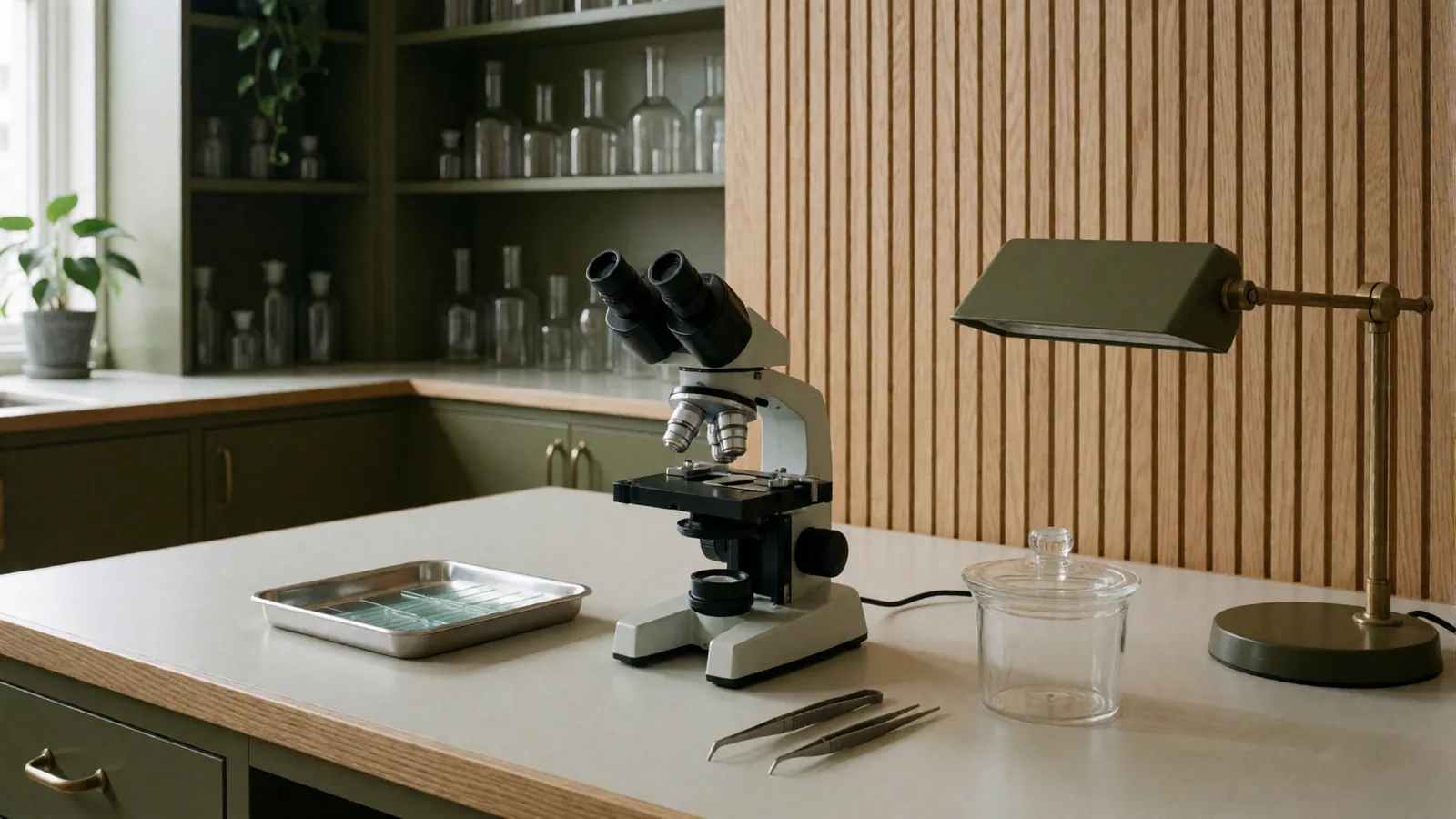
A handheld magnifier with cross-polarised light, pressed against the skin, which cancels the surface glare and shows the pigment network and vessel patterns underneath. It is the single largest improvement in diagnosing skin cancer in fifty years, it takes ten seconds per lesion, and it is why we can leave alone a great many marks that would otherwise be cut out to be safe. You are welcome to look through it, and most people ask to.
Punch biopsy
A circular blade, three or four millimetres across, taking a full-thickness core of skin under local anaesthetic. It is the right sample for a rash, because a pathologist needs to see all the layers to say what is happening in them. One or two stitches, out in a week, and a pale mark the size of a match head.
Shave and excisional biopsy
A shave takes the raised part of a lesion flat to the surface and is right for growths that are clearly sitting on top of the skin. An excision takes the whole thing with a margin around it and goes deeper than the lesion does, which is what anything possibly cancerous needs — a partial sample of a melanoma can mislead a pathologist about how deep it goes, and depth is the number that matters most.
Cryotherapy
Liquid nitrogen at minus 196 degrees, applied in short bursts, freezing and killing the treated tissue so it blisters and separates over a fortnight. It is quick and effective for sun-damage patches, warts and several harmless growths. It stings sharply for about twenty seconds, it usually leaves a pale mark, and on deeper skin tones that pale mark can be permanent — which is a genuine reason to choose something else, and a conversation we have before rather than after.
Electrosurgery and curettage
Scraping a lesion away with a curette and sealing the base with a fine electrical current. Fast, done under local anaesthetic, and the standard approach for several harmless growths and for some very early, low-risk cancers in the right place on the right person. It heals as a flat pale circle rather than a line.
Narrowband ultraviolet phototherapy
A specific wavelength of ultraviolet light that damps down the immune activity in skin, delivered in a cabinet two or three times a week for a course of months. It is genuinely effective for widespread psoriasis, some eczema and vitiligo, it avoids systemic medication entirely, and its cost is time — a course is dozens of visits. It also carries the long-term risks that any repeated ultraviolet exposure carries, which is why the doses are recorded and totalled across your life rather than per course.
Patch testing
Panels of standardised allergens taped to the back for forty-eight hours, then read twice: once when they come off and once two days later, because many reactions arrive late. It is the only reliable way to identify a contact allergy, and it distinguishes an allergy from an irritation, which look identical and need entirely different advice.
Intralesional injection
A small amount of steroid injected directly into a thickened scar, a stubborn patch of inflammation or an acutely inflamed cyst. It works where a cream cannot reach, it flattens a keloid over several months, and it can settle an acute painful nodule within a day or two. It can leave a dent or a pale halo at the site, which usually recovers over months.
We claim nobody else's approval, and we name nobody's product. Dermatology is regulated in New York State, every physician here is licensed, and the practice is inspected like any other medical office. What we will not do is decorate this website with the seal of a board, a college or an academy as though somebody outside this building has personally vouched for the care you are about to receive. Nobody outside this practice has reviewed it. So instead of a wall of logos, these pages tell you plainly who will examine you, what they will do, what they will not do, what it costs, what can go wrong and how often. Ask us about any of it before you book.
Why the pathologist matters as much as the dermatologist
Almost every certain diagnosis in this speciality is made by somebody you never meet, looking down a microscope at a piece of you.
A biopsy is not a formality. The sample is processed, cut into sections thinner than a cell, stained and examined, and where the appearance is ambiguous the pathologist orders additional stains to distinguish between possibilities. That is why a report occasionally takes longer than a week, and why being told it is taking longer is thoroughness rather than bad news.
It also means the quality of the sample determines the quality of the answer. A punch that is too superficial for a rash, a shave through a pigmented lesion that leaves the depth unknowable, a sample taken from the wrong part of a patch — each of those produces a report that is technically accurate and clinically useless. Choosing the right technique and the right site is most of the value of the procedure, and it is decided before anything is opened.
Questions
How we work — the questions we are asked most
Why does everything end in a biopsy?
It does not — most appointments end in a diagnosis made by history and examination. But where there is genuine doubt, a biopsy is what settles it, and settling it is better than monitoring. We would far rather sample something that turns out to be nothing than watch a mark for a year.
Is the dermatoscope a scan?
No. It is a magnifying lens with a light, held against the skin, emitting nothing into you. It takes about ten seconds per mark and it is simply a much better way of looking. You are welcome to look through it, and most people ask to.
Do these procedures hurt?
Cryotherapy stings sharply for about twenty seconds. Anything involving a blade is done under local anaesthetic, where the only painful part is ten seconds while the anaesthetic goes in. Intralesional injections into dense scar tissue are briefly uncomfortable. Patch testing and phototherapy do not hurt at all.
Why will you not tell me what equipment you use?
In the room we will, in detail. What you will not find on this website is a manufacturer's name, because device and drug brands get named on medical sites to borrow authority and to make you shop for a machine rather than for the person deciding whether you need it.
The risks, plainly. Every treatment described here has side effects, and some carry real risks. Topical steroids thin skin if they are used at the wrong strength on the wrong site for too long, which is why they are prescribed with a site, a strength and a stopping point rather than handed over indefinitely. Light-based and laser treatment can burn, blister and cause pigment change that lasts months, and that risk is higher on deeper skin tones and on recently tanned skin. Any procedure that breaks the skin can bleed, become infected and leave a scar; on the chest, the shoulders and the jawline, scars are more likely to thicken. Several of the medicines used in this speciality require blood tests, and some cannot be taken during pregnancy. We tell you your own risk rather than the average one, and where the honest answer is that a condition is better left alone, that is the advice you will get.
A named diagnosis and a written plan you leave holding
Book an appointment
Pick a physician and a time from the calendar — it shows only the hours each of them genuinely has free. A new patient appointment is thirty minutes, a full skin examination forty-five, and you leave with a named diagnosis written down. If something on your skin has changed, telephone instead and say that word: it is triaged differently.