
Some things should not wait for the next free routine appointment. Some things should not wait for the next free routine appointment. Telephone the practice and say what is happening, or go to an emergency room, if you have a mole or a mark that has changed shape, colour or size, that has become raised or uneven, or that bleeds, itches or will not heal; a sore anywhere that has not healed in three weeks; a rash that is spreading quickly, especially with fever, blistering, or peeling skin; a painful rash in a band on one side of the body, particularly near an eye; redness that is hot, swollen, tender and spreading, which can be a deep skin infection; a new rash after starting a medicine, especially with mouth or eye involvement; or a child under three months with any widespread rash. If you have been treated here and something is worse rather than better after a procedure, telephone us rather than waiting for the review appointment. We would far rather field a call that turns out to be nothing.
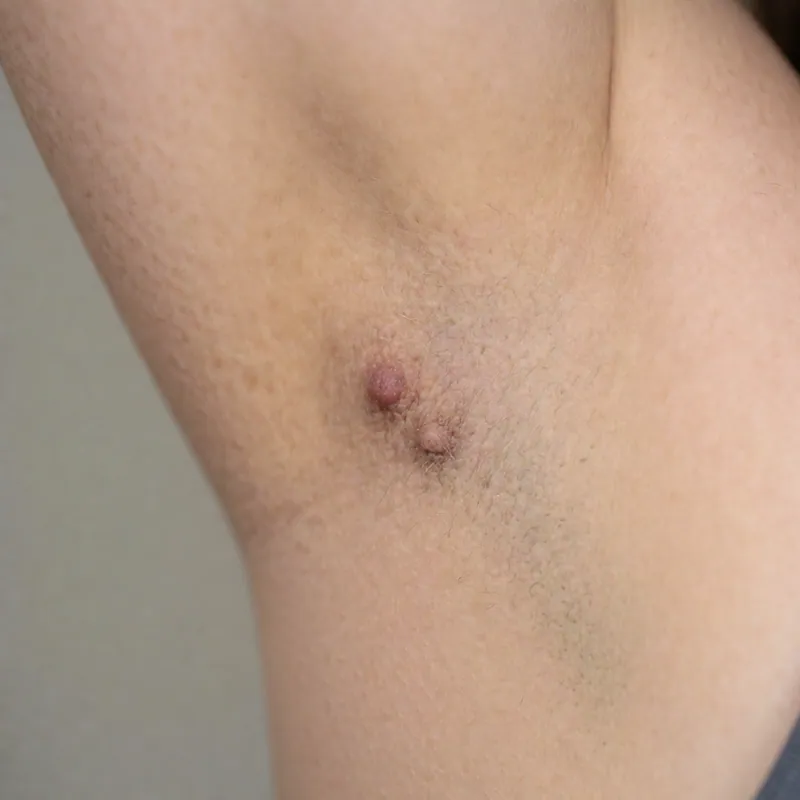
Hidradenitis suppurativa is a chronic inflammatory disease of hair follicles in areas where skin rubs against skin — the armpits, the groin, the inner thighs, under the breasts and between the buttocks. It produces deep, painful nodules that may rupture and discharge, tracts running under the skin between them, and scarring over time. It is far more common than its recognition rate suggests, and the typical patient has had it for years before it is named.
Two misunderstandings do most of the damage. The first is that it is an infection: it is not, which is why repeated courses of antibiotics for individual lesions do not stop it returning — antibiotics are used here, but for their anti-inflammatory effect and as part of a strategy rather than as a cure for each abscess. The second is that it is caused by poor hygiene, which is untrue and is the belief that keeps people from seeking help. Patients routinely arrive having concluded that the problem is them.
The delay matters clinically, not only emotionally. Early disease responds to medical treatment; established tracts and scarring do not resolve with medicine and need surgery. Every year spent undiagnosed converts treatable inflammation into permanent structural damage. If any of this describes you, the appointment is worth making — this is one of the conditions in this practice where the difference between being seen and not being seen is largest.
Treatment, by stage
What is appropriate depends on how much scarring and tracting has already happened.
Topical antiseptic and antibiotic treatment
Antiseptic washes used regularly on affected areas reduce flare frequency for many people, and a topical antibiotic helps mild disease. Simple, cheap and worth doing at every stage alongside everything else.
Oral antibiotics used as anti-inflammatories
Longer courses at doses chosen for their effect on inflammation rather than to treat an infection. Certain combinations are used for moderate disease over months. This is where the difference from "a course of antibiotics for a boil" matters — the drug is the same, the reasoning is not.
Hormonal treatment, where the pattern fits
Some patients flare with the menstrual cycle and respond to hormonal treatment or to an anti-androgen tablet, in the same way that some acne does.
A tablet used off-licence for its effect on inflammation
There is a widely used oral medicine, originally developed for something else, that has a genuine role here and is cheap. It requires monitoring.
Targeted injectable treatment for moderate to severe disease
Biologic treatments that block specific inflammatory signals are now an established option for this condition and have changed what is achievable in severe cases. Screening beforehand and monitoring afterwards are required, as with psoriasis. None is named here; that conversation happens in the room.
Steroid injection into an acute painful nodule
Settles an individual inflamed lump within a day or two and is genuinely useful for getting somebody through a week. Not a treatment for the disease.
Surgery for established tracts and scarring
Once tracts and scarring exist, medicine will not remove them. Deroofing — laying a tract open so it heals flat — is a relatively small procedure with good results for localised disease. Wider excision of a badly affected area is a bigger operation and is referred. Incision and drainage of an abscess relieves pain but the lesion recurs, so it is a relief measure and not a plan.
The things that genuinely help alongside
Offered as levers within your control, not as an implication that this is your fault.
Stopping smoking
Smoking is strongly associated with this condition and with how severe it is. Stopping is the single most effective non-medical change available, and it is worth support to achieve rather than a sentence in a letter.
Weight, where it applies
Weight loss reduces flare frequency for many people, largely through reducing friction and skin-on-skin contact. It is a real factor and it is not the cause — people of every size have this condition.
Reducing friction
Loose clothing, natural fibres, avoiding tight waistbands and seams over affected areas. Antiperspirant in the armpits is fine and does not cause this.
Pain treated as a real problem
This condition hurts, sometimes severely, and pain is under-treated in it. Say so plainly — pain management is part of the plan rather than an afterthought, and unmanaged pain is a legitimate reason to escalate treatment.
Mental health, said out loud
Rates of depression are high in this condition, for entirely understandable reasons: it is painful, it is in intimate areas, it discharges, it is frequently misattributed to hygiene, and it affects relationships and work. Raising it here is normal and it changes what we recommend.
Hidradenitis Suppurativa in western Queens
Painful recurring lumps and abscesses in the armpits, groin, under the breasts and between the buttocks. Frequently misdiagnosed as boils for a decade. It is an inflammatory disease, it is treatable, and the average delay to diagnosis is the scandal of this condition.
Every appointment here starts the same way: a proper history, an examination in good light, and a named diagnosis said out loud and written down for you to take home. If there is genuine doubt you will be told that, and told what would settle it — usually a biopsy. You leave with a plan that has a strength, a site, a frequency and a date to stop or come back on it, and, where the condition is one that relapses, what to do on the first day of the next flare. If the honest answer is that this is better left alone, or that it belongs somewhere other than here, that is what you get instead, and it costs exactly the same.

This page is not medical advice, and it is not a diagnosis. Nothing on this website is medical advice for you in particular, and it is not a diagnosis. These pages describe conditions in general terms so that you arrive knowing what the questions are — they cannot tell you which condition you have, because that requires somebody to look at your skin, feel it, ask you a hundred questions and frequently take a sample of it. Two conditions on this website can look identical in a photograph and need opposite treatments. If something on your skin is new, changing, painful or not healing, the useful next step is an appointment rather than more reading.
No before-and-after photographs, and no promised outcome. There are no before-and-after photographs on this website and there never will be. Every set you have seen somewhere else was chosen from a much larger pile, and the second picture is usually taken in different light, at a different angle, at a different point in a flare cycle. In dermatology the dishonesty is sharper than in most fields, because nearly every condition here fluctuates on its own — photograph any relapsing skin disease at its worst and again at its best and you have a persuasive pair of images that demonstrates nothing about the treatment in between. What we publish instead is what a treatment typically achieves, in how long, in what proportion of people, and how often it does not work.
The risks, plainly. Every treatment described here has side effects, and some carry real risks. Topical steroids thin skin if they are used at the wrong strength on the wrong site for too long, which is why they are prescribed with a site, a strength and a stopping point rather than handed over indefinitely. Light-based and laser treatment can burn, blister and cause pigment change that lasts months, and that risk is higher on deeper skin tones and on recently tanned skin. Any procedure that breaks the skin can bleed, become infected and leave a scar; on the chest, the shoulders and the jawline, scars are more likely to thicken. Several of the medicines used in this speciality require blood tests, and some cannot be taken during pregnancy. We tell you your own risk rather than the average one, and where the honest answer is that a condition is better left alone, that is the advice you will get.
Nothing is diagnosed from a photograph. We do not diagnose skin from photographs, and we do not answer "what is this?" by email, by message or through a form. This is not caution for its own sake. A photograph has no history attached to it, cannot be felt, cannot be stretched or pressed to see whether the colour blanches, cannot be examined under a dermatoscope, and misreports colour badly — which matters enormously on skin that is not pale. The examination that actually distinguishes a harmless growth from an early cancer involves magnification, cross-polarised light and, when there is any doubt at all, a biopsy. An application that offers to tell you whether a mole is dangerous from a picture taken on a telephone is selling reassurance, and reassurance is the one product in this field that is dangerous when it is wrong. Bring the mark to a room where somebody can look at it.
Questions
Hidradenitis Suppurativa — the questions we are asked most
Is this caused by poor hygiene?
No. It is a chronic inflammatory disease of hair follicles, it is not an infection, and washing more does not prevent it. This belief is the main reason people wait years before seeking help, and it is worth saying plainly: nothing about having this condition reflects on how you look after yourself.
Why do antibiotics only work for a while?
Because the underlying problem is inflammation rather than infection. A course settles a flare and the disease is still there. Antibiotics do have a real role here, but as long-course anti-inflammatory treatment within a wider plan, not as repeated short courses for each new lump.
Will it ever go away?
It is a long-term condition that is controlled rather than cured, and it tends to fluctuate over years. What is achievable, particularly with modern treatment, is far fewer flares, much less pain and stopping the progression to scarring. Areas that have already scarred need surgery, not medicine.
Should I have the lumps drained?
Draining an acutely painful abscess relieves the pain and is sometimes exactly what is needed on the day. It does not stop it recurring, and repeated incision and drainage of the same site is a sign the underlying disease is not being treated. A steroid injection often settles an inflamed nodule without cutting it.
I have been told it is boils for years. How do I know which it is?
The pattern is the clue: recurring in the same skin folds, on both sides, over years, with tracts or scarring between lesions, often with blackhead-like double pores in the area. Recurrent lesions in the armpits, groin or under the breasts should be assessed for this specifically. That assessment is the appointment.
Does stopping smoking really make a difference?
Yes, and it is the single most effective non-medical measure for this condition. That is offered as something genuinely within your control rather than as a reproach, and we would rather help you do it than mention it and move on.
Related
Often seen alongside this

Inflammatory Skin Disease
Acne
The commonest reason anybody sees a dermatologist. It is treatable in almost everybody, it takes about three months before you can judge whether a treatment worked, and treating it properly is how you avoid the scars.
Read more
Inflammatory Skin Disease
Eczema & Dermatitis
Itchy, inflamed, dry skin that flares and settles. It is controlled rather than cured, most of it is under-treated rather than over-treated, and the plan you leave with should include what to do on the first day of the next flare.
Read more
Inflammatory Skin Disease
Psoriasis
An immune-driven condition, not a skin infection and not contagious. Treatment ranges from creams through light therapy to targeted injections, and what has become achievable for severe psoriasis in the last decade is genuinely different from what came before.
Read moreA named diagnosis and a written plan you leave holding
Book an appointment
Pick a physician and a time from the calendar — it shows only the hours each of them genuinely has free. A new patient appointment is thirty minutes, a full skin examination forty-five, and you leave with a named diagnosis written down. If something on your skin has changed, telephone instead and say that word: it is triaged differently.