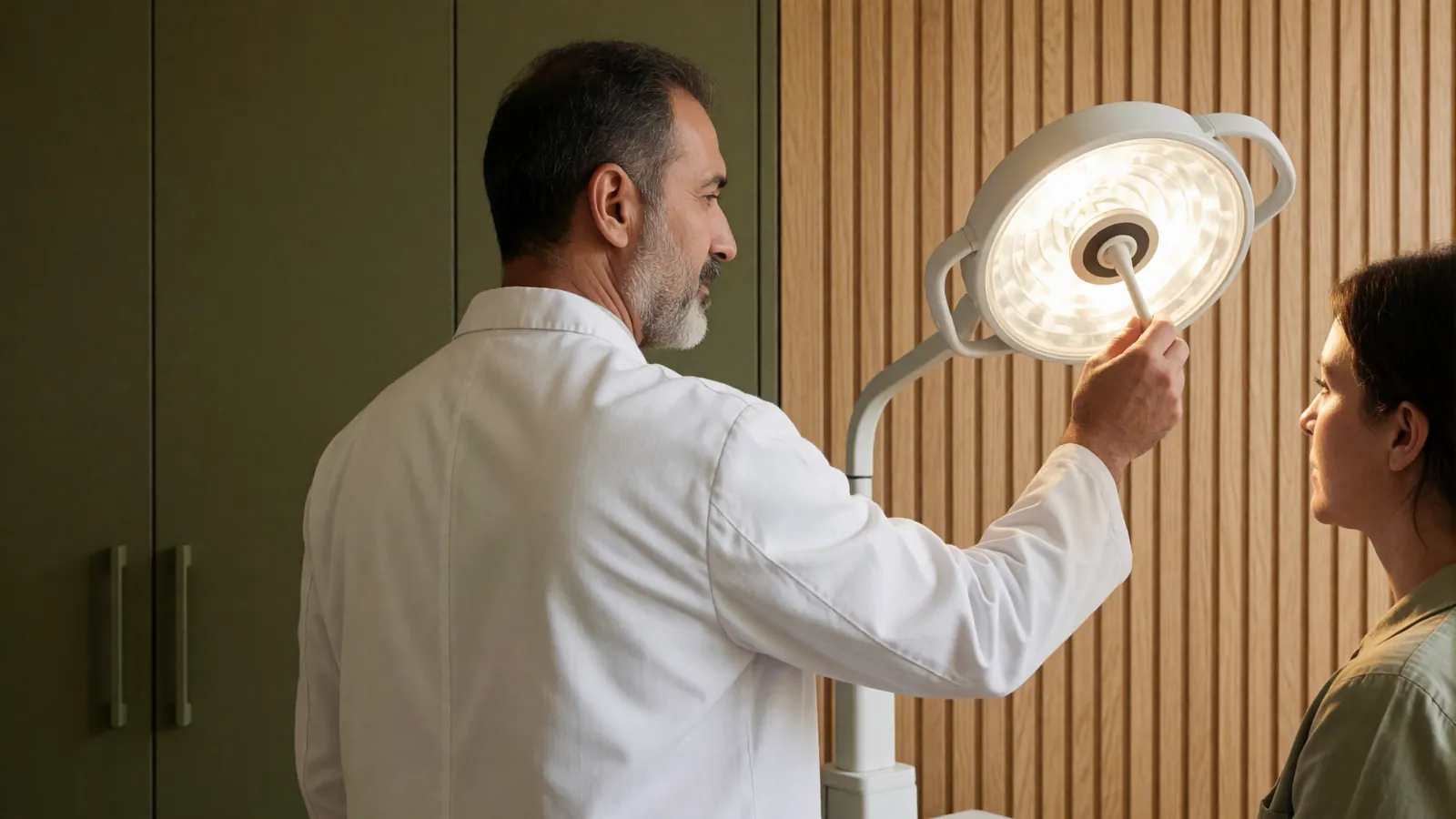
Some things should not wait for the next free routine appointment. Some things should not wait for the next free routine appointment. Telephone the practice and say what is happening, or go to an emergency room, if you have a mole or a mark that has changed shape, colour or size, that has become raised or uneven, or that bleeds, itches or will not heal; a sore anywhere that has not healed in three weeks; a rash that is spreading quickly, especially with fever, blistering, or peeling skin; a painful rash in a band on one side of the body, particularly near an eye; redness that is hot, swollen, tender and spreading, which can be a deep skin infection; a new rash after starting a medicine, especially with mouth or eye involvement; or a child under three months with any widespread rash. If you have been treated here and something is worse rather than better after a procedure, telephone us rather than waiting for the review appointment. We would far rather field a call that turns out to be nothing.
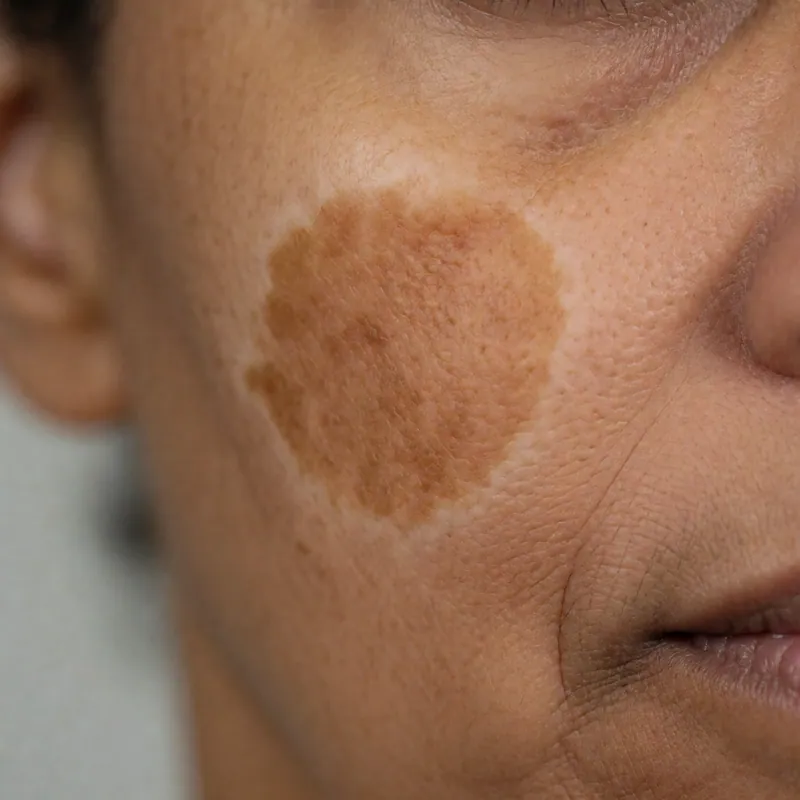
Melasma produces symmetrical brown or grey-brown patches, most often across the cheekbones, the forehead, the upper lip and the jawline. It is far more common in women, and much more common in people with medium to deep skin tones. Its triggers are hormonal — pregnancy, the contraceptive pill, hormone therapy — combined with light exposure, and it frequently begins during a pregnancy and then persists.
The thing that makes melasma different from other pigmentation, and the reason it defeats so many treatment plans, is that ultraviolet light is only part of the problem. Visible light — ordinary daylight, and to a lesser extent screens — also drives it, particularly on deeper skin tones. That is why an ordinary clear sunscreen protecting against ultraviolet alone is frequently not enough, and why the recommendation here is a tinted mineral sunscreen containing iron oxide, which blocks visible light as well. This single change is the most effective intervention available and it is the one most often missing.
The second thing worth saying at the outset is that aggressive treatment makes melasma worse. Skin with melasma responds to injury by producing more pigment, so vigorous peels, strong lasers and enthusiastic exfoliation reliably produce a rebound that is harder to treat than what was there before. The correct approach is patient, gentle and long-term, and it is genuinely difficult to sell — which is why so many people have been sold something else.
What works, honestly ranked
Slow and gentle beats fast and strong here more clearly than anywhere else in this practice.
Tinted mineral sunscreen with iron oxide, every single day
This is the treatment, not an adjunct to it. Broad spectrum, at least SPF 30, tinted, containing iron oxide for visible light, applied every morning including in winter, indoors near windows, and reapplied outdoors. Patients who do everything else and skip this do not improve; patients who do only this often do.
A hat and shade
A wide brim does more for a forehead and cheekbones than any bottle, and it does not wear off. For anybody outdoors regularly this is a large part of the answer.
Topical combination treatment
The standard approach combines agents that reduce pigment production with a retinoid and a mild anti-inflammatory. It works, it takes about three months to show, and the strongest pigment-reducing agent is used in courses of a few months rather than continuously — long uninterrupted use carries a risk of a paradoxical darkening that is considerably harder to treat than the melasma.
Milder maintenance agents for the long term
Several gentler pigment-reducing ingredients are suitable for continuous use and are what most people stay on between courses. Maintenance is the whole game in melasma — stopping everything after improvement is exactly how it returns.
An oral option, in selected cases
There is an oral medicine, originally used for something else entirely, that reduces melasma in a meaningful proportion of people. It is not suitable for anybody with a history of clotting, and it requires a careful history first. It is prescribed here with that discussion rather than casually.
Very superficial peels, conservatively
Light peels can help as part of a plan. Strength and agent depend on skin tone, and starting conservatively and building is the only sensible approach — a peel that is too strong here causes a rebound that sets treatment back many months.
Reviewing hormonal triggers, where that is possible
If melasma began with a contraceptive pill or hormone therapy, changing it may help — that is a conversation with whoever prescribes it, and it is not always possible or desirable. Pregnancy-related melasma often fades after delivery, though it may not fade completely.
What makes it worse
Several of these are things done specifically in an attempt to treat it.
Any sun exposure at all
Including through car and office windows, on cloudy days, and in winter. Melasma darkens every summer and lightens every winter for nearly everybody who has it, which is why a treatment started in spring frequently appears not to be working.
Heat, independently of light
Cooking over a stove, saunas, hot yoga and hot facial treatments all appear to aggravate melasma through heat rather than through light. Worth knowing if your work involves it.
Aggressive lasers and strong peels
The commonest way a person's melasma is made permanently worse. Skin with melasma responds to injury with more pigment. Any laser used for melasma should be at conservative settings by somebody who treats a great deal of it, and the honest position is that it is a limited adjunct rather than a solution.
Scrubbing and exfoliating
Physical scrubs and vigorous exfoliation inflame the skin, and inflammation produces pigment. A considerable amount of stubborn melasma is melasma plus an aggressive routine adopted in response to it.
Irritating skincare
Anything that stings, burns or leaves the skin red is working against you. Gentle cleanser, moisturiser, tinted sunscreen, and whatever has actually been prescribed.
Stopping treatment when it improves
The single commonest reason it returns. Melasma requires maintenance indefinitely, and the plan should include what you do after the active phase rather than ending with it.
Melasma in western Queens
Symmetrical brown patches across the cheeks, forehead and upper lip, driven by hormones and light. It is the most stubborn pigmentation in dermatology, it relapses reliably, and daily sun protection is not advice here — it is the treatment.
Every appointment here starts the same way: a proper history, an examination in good light, and a named diagnosis said out loud and written down for you to take home. If there is genuine doubt you will be told that, and told what would settle it — usually a biopsy. You leave with a plan that has a strength, a site, a frequency and a date to stop or come back on it, and, where the condition is one that relapses, what to do on the first day of the next flare. If the honest answer is that this is better left alone, or that it belongs somewhere other than here, that is what you get instead, and it costs exactly the same.
This page is not medical advice, and it is not a diagnosis. Nothing on this website is medical advice for you in particular, and it is not a diagnosis. These pages describe conditions in general terms so that you arrive knowing what the questions are — they cannot tell you which condition you have, because that requires somebody to look at your skin, feel it, ask you a hundred questions and frequently take a sample of it. Two conditions on this website can look identical in a photograph and need opposite treatments. If something on your skin is new, changing, painful or not healing, the useful next step is an appointment rather than more reading.
No before-and-after photographs, and no promised outcome. There are no before-and-after photographs on this website and there never will be. Every set you have seen somewhere else was chosen from a much larger pile, and the second picture is usually taken in different light, at a different angle, at a different point in a flare cycle. In dermatology the dishonesty is sharper than in most fields, because nearly every condition here fluctuates on its own — photograph any relapsing skin disease at its worst and again at its best and you have a persuasive pair of images that demonstrates nothing about the treatment in between. What we publish instead is what a treatment typically achieves, in how long, in what proportion of people, and how often it does not work.
The risks, plainly. Every treatment described here has side effects, and some carry real risks. Topical steroids thin skin if they are used at the wrong strength on the wrong site for too long, which is why they are prescribed with a site, a strength and a stopping point rather than handed over indefinitely. Light-based and laser treatment can burn, blister and cause pigment change that lasts months, and that risk is higher on deeper skin tones and on recently tanned skin. Any procedure that breaks the skin can bleed, become infected and leave a scar; on the chest, the shoulders and the jawline, scars are more likely to thicken. Several of the medicines used in this speciality require blood tests, and some cannot be taken during pregnancy. We tell you your own risk rather than the average one, and where the honest answer is that a condition is better left alone, that is the advice you will get.
Nothing is diagnosed from a photograph. We do not diagnose skin from photographs, and we do not answer "what is this?" by email, by message or through a form. This is not caution for its own sake. A photograph has no history attached to it, cannot be felt, cannot be stretched or pressed to see whether the colour blanches, cannot be examined under a dermatoscope, and misreports colour badly — which matters enormously on skin that is not pale. The examination that actually distinguishes a harmless growth from an early cancer involves magnification, cross-polarised light and, when there is any doubt at all, a biopsy. An application that offers to tell you whether a mole is dangerous from a picture taken on a telephone is selling reassurance, and reassurance is the one product in this field that is dangerous when it is wrong. Bring the mark to a room where somebody can look at it.
Questions
Melasma — the questions we are asked most
Can melasma be cured?
No. It is controlled rather than cured, it relapses with sun and with hormonal change, and it requires maintenance indefinitely. What is achievable is patches that are considerably lighter and much less noticeable, held there by daily sun protection and ongoing maintenance treatment. Anybody promising to remove it permanently has not treated much of it.
Why does my sunscreen not seem to be helping?
Very possibly because it protects against ultraviolet only. Melasma is also driven by visible light, particularly on deeper skin tones, and a clear sunscreen does not block that. A tinted mineral sunscreen containing iron oxide does, and switching is the single most effective change most patients make.
Will it go away after my pregnancy?
It often fades substantially in the months after delivery, and it may not go completely, and it commonly returns in a subsequent pregnancy. Treatment during pregnancy is limited — several standard agents are not used then — so the plan during pregnancy is chiefly rigorous sun protection, with active treatment afterwards.
Should I have laser treatment?
Usually not, and this is where a great deal of harm is done. Melasma responds to injury by producing more pigment, so aggressive laser reliably produces a rebound that is worse and harder to treat. There is a limited role for conservative settings in experienced hands as part of a wider plan. If somebody offers to clear your melasma with a course of laser, that is a reason to leave.
Is the strong pigment-reducing cream safe to use forever?
No, and this matters. The strongest agent is used in courses of a few months with breaks, because prolonged uninterrupted use carries a risk of a paradoxical darkening that is considerably harder to treat than the melasma itself. Milder agents are used for maintenance in between. A plan that has you on the strong one indefinitely is not a good plan.
Does it get worse in summer?
For nearly everybody, yes, and it lightens in winter. This is worth planning around: the active phase of treatment is best started in autumn, and a course begun in spring frequently appears to fail simply because the season is working against it.
Related
Often seen alongside this
Pigment & Skin Tone
Marks After Inflammation
The brown, grey or purple marks left behind by acne, eczema, an injury or an insect bite. They are not scars and they do fade — slowly, over six to eighteen months, and far faster with daily sun protection than with anything else.
Read more
Pigment & Skin Tone
Vitiligo
An autoimmune condition in which pigment cells are lost, producing well-defined pale patches. It is not contagious, it is not caused by diet, and treatment has genuinely improved — repigmentation is possible, slow, and better at some sites than others.
Read more
Pigment & Skin Tone
Skin of Color Dermatology
Not a separate speciality — a set of things that are genuinely different and that this field's defaults were not built around. Redness reads differently, pigment change is the presenting complaint more often than the disease, and every light-based treatment carries different risk.
Read moreA named diagnosis and a written plan you leave holding
Book an appointment
Pick a physician and a time from the calendar — it shows only the hours each of them genuinely has free. A new patient appointment is thirty minutes, a full skin examination forty-five, and you leave with a named diagnosis written down. If something on your skin has changed, telephone instead and say that word: it is triaged differently.