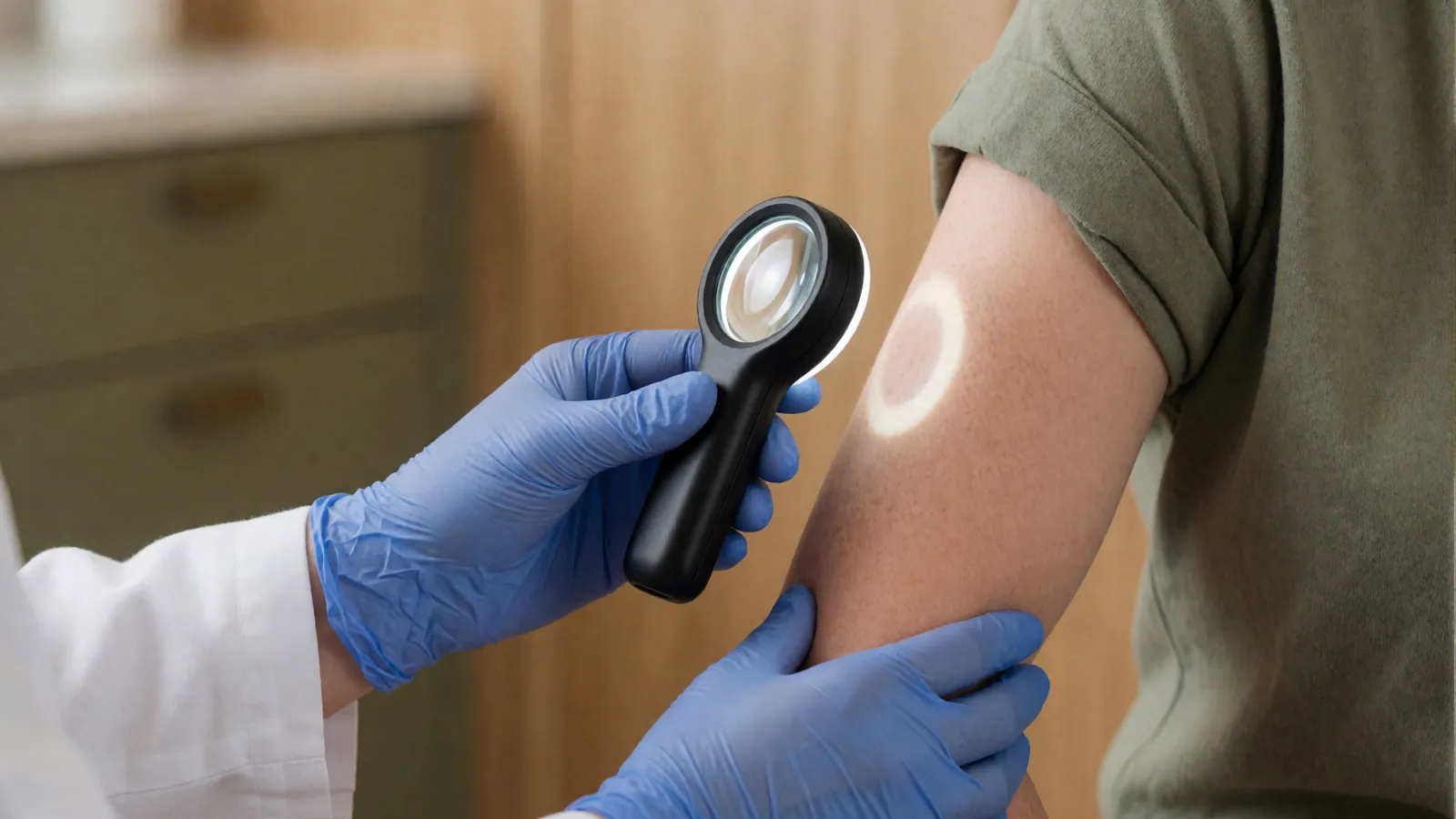
Nothing is diagnosed from a photograph. We do not diagnose skin from photographs, and we do not answer "what is this?" by email, by message or through a form. This is not caution for its own sake. A photograph has no history attached to it, cannot be felt, cannot be stretched or pressed to see whether the colour blanches, cannot be examined under a dermatoscope, and misreports colour badly — which matters enormously on skin that is not pale. The examination that actually distinguishes a harmless growth from an early cancer involves magnification, cross-polarised light and, when there is any doubt at all, a biopsy. An application that offers to tell you whether a mole is dangerous from a picture taken on a telephone is selling reassurance, and reassurance is the one product in this field that is dangerous when it is wrong. Bring the mark to a room where somebody can look at it.
Seven reasons
What a photograph cannot do
Each of these is a specific thing the examination does and the image does not. Together they are why the rule is firm rather than a preference.
A photograph has no history attached to it
More than half of dermatological diagnosis is the history, not the appearance. When did it start, where did it start, what did it look like then, what makes it worse, what have you already put on it, what else has changed about you, what do you handle all day, what do you take. A picture answers none of those, and two conditions that look identical in an image are separated by the answers.
It cannot be felt
Whether a lesion is soft or firm, fixed or mobile, tender or silent, warm or not, flat or raised by a fraction of a millimetre — none of that survives a photograph, and several of those findings are the difference between a harmless growth and one that gets removed today.
It cannot be pressed
Pressing a red mark to see whether the colour blanches is one of the oldest tests in medicine and one of the most important. A rash that does not blanch under pressure can mean bleeding into the skin, and in a child with fever that is an emergency. No photograph will tell you that.
It cannot be dermoscoped
The instrument that actually distinguishes an ordinary mole from an early melanoma is a magnifier with cross-polarised light held against the skin, which cancels the surface glare and reveals the pigment network and vessel patterns beneath it. That view does not exist in a photograph taken on a telephone, and it is the view the decision is made on.
It misreports colour, and worst on the skin where it matters most
Cameras, automatic white balance, screen calibration and ambient light all shift colour substantially. On skin that is not pale this is more than a nuisance: inflammation presents as violet, grey or simply darker rather than pink, and a photograph flattens exactly the distinction that was already the hardest to see.
The dangerous ones are frequently the least dramatic
The fast-growing form of melanoma is often small, symmetrical, evenly coloured and sometimes pink rather than brown — it fails every letter of the familiar checklist and looks tidier than the harmless mole beside it. An image is precisely the wrong evidence for that.
Wrong reassurance is worse than no answer
This is the whole argument. If somebody looks at a picture and tells you it appears fine, you stop thinking about it, and you do not book. A person who is told nothing books an appointment; a person who is told it looks fine waits a year. That is why this is a firm rule rather than a preference — the failure mode of a casual opinion is not neutral, it is delay.
The industry around it
Applications, group chats and image searches
All four of these are ways of getting an answer without an examination, and all four fail in the same direction.
Automated mole-checking applications
An application that grades a mole from a telephone photograph is selling reassurance, and reassurance is the one product in this field that is dangerous when it is wrong. Even where such a system performs respectably on average, the relevant question is what happens to the person it gets wrong — and the answer is that they stop worrying about the thing that needed removing. Photograph your own marks for your own comparison over time, which is genuinely useful. Do not let anything grade them.
Sending a picture to a doctor you know socially
A universal habit and an understandable one. The person you are asking is being put in an impossible position: they cannot examine you, they do not have your history, and they know that saying "it looks fine" is what you want to hear. Most of them will tell you to get it looked at, and they are right.
Searching your symptoms against images
Comparing your own skin against pictures online mostly produces false reassurance, because for every condition there are hundreds of appearances and the images published are the photogenic ones. The useful version of reading about a condition is arriving knowing what the questions are, which is what the pages on this site are written for.
The illustrations on this website, and what they are not
The condition pages carry an illustrative image of a typical presentation, and every one of them is labelled as an illustration rather than a photograph of a patient. They are there to show you roughly what a condition looks like so that the words make sense. They are not a reference set to compare yourself against, and they cannot be: presentations vary enormously, the same condition looks different on different skin tones, and the dangerous things are frequently the least dramatic. If you find yourself holding your arm next to a picture on this site, that is the moment to book rather than to conclude.
Where it does help
What a photograph is genuinely useful for
This is not a rejection of images. It is a rejection of images used instead of an examination — used alongside one, several of them are valuable.
Following up a condition we have already examined in person
Reviewing whether a treatment plan is working, adjusting a dose, or looking at a flare of something already diagnosed and already seen. This is genuinely useful and it is what our video follow-up appointments are for.
Photographs you take of your own skin, for your own comparison
With something for scale, in the same light, from the same distance. Comparing a mark against itself over months is the one thing a photograph does well in this field. Bring them to the appointment — they are useful evidence alongside an examination, and useless instead of one.
Showing us what a rash looked like at its worst
Rashes are inconvenient and frequently settle by the day of the appointment. A photograph of the eruption at its height is genuinely valuable to somebody who is also examining you, taking your history and able to sample it.
Sending a picture of a product label
Which is a completely different thing from sending a picture of skin, and it is welcome. Better still, bring the actual containers.
This page is not medical advice, and it is not a diagnosis. Nothing on this website is medical advice for you in particular, and it is not a diagnosis. These pages describe conditions in general terms so that you arrive knowing what the questions are — they cannot tell you which condition you have, because that requires somebody to look at your skin, feel it, ask you a hundred questions and frequently take a sample of it. Two conditions on this website can look identical in a photograph and need opposite treatments. If something on your skin is new, changing, painful or not healing, the useful next step is an appointment rather than more reading.
What we would rather you did
Book. If you are worried enough to be looking for somebody to look at a picture, that is already the answer.
An appointment about a single mark takes fifteen minutes and costs $150, or $225 for a full examination of all of your skin, which is where most of what gets found is actually found. Most of these appointments end in reassurance — and reassurance from an examination is worth something, whereas reassurance from an image is worth less than nothing because of what it stops you doing.
If something has changed, telephone rather than booking online and say that word. It is triaged differently.
Questions
The objections we hear most
I only want to know whether it is worth an appointment.
That is the question that cannot be answered from an image, and it is the one where a wrong answer costs the most. If you are asking it, the answer is yes — book. A short appointment that ends in reassurance is a good outcome and it is what most of them are.
What if I cannot easily get in?
Telephone and say what is happening. Something that has changed is triaged differently from a routine appointment, and we would far rather field a call that turns out to be nothing than have somebody wait for a convenient slot with a changing mark.
Are your video appointments not the same thing?
No, and the difference is the boundary. They are for established patients with a condition already examined here in person, for following it up. They are not used for a new lesion, a new rash, anything on a nail, anything pigmented, or anything that needs to be felt — and where a video appointment reaches that boundary we convert it to an in-person one rather than guess.
Other practices offer photograph assessment. Why do you not?
Some do it well, within careful limits, as part of a service where the patient is already known and there is a clear route to being seen. What we will not do is offer it as a substitute for an examination to somebody who has never been here, because the person harmed by that is invisible — they are the one who was reassured and did not come back.
Is this just about liability?
No. If it were, the safe answer would be to look at every picture and tell everybody to come in, which costs us nothing and protects us entirely. The reason for the rule is that a casual opinion given from an image reliably produces the one outcome that matters here, which is delay.
No before-and-after photographs, and no promised outcome. There are no before-and-after photographs on this website and there never will be. Every set you have seen somewhere else was chosen from a much larger pile, and the second picture is usually taken in different light, at a different angle, at a different point in a flare cycle. In dermatology the dishonesty is sharper than in most fields, because nearly every condition here fluctuates on its own — photograph any relapsing skin disease at its worst and again at its best and you have a persuasive pair of images that demonstrates nothing about the treatment in between. What we publish instead is what a treatment typically achieves, in how long, in what proportion of people, and how often it does not work.
A named diagnosis and a written plan you leave holding
Book an appointment
Pick a physician and a time from the calendar — it shows only the hours each of them genuinely has free. A new patient appointment is thirty minutes, a full skin examination forty-five, and you leave with a named diagnosis written down. If something on your skin has changed, telephone instead and say that word: it is triaged differently.