
Some things should not wait for the next free routine appointment. Some things should not wait for the next free routine appointment. Telephone the practice and say what is happening, or go to an emergency room, if you have a mole or a mark that has changed shape, colour or size, that has become raised or uneven, or that bleeds, itches or will not heal; a sore anywhere that has not healed in three weeks; a rash that is spreading quickly, especially with fever, blistering, or peeling skin; a painful rash in a band on one side of the body, particularly near an eye; redness that is hot, swollen, tender and spreading, which can be a deep skin infection; a new rash after starting a medicine, especially with mouth or eye involvement; or a child under three months with any widespread rash. If you have been treated here and something is worse rather than better after a procedure, telephone us rather than waiting for the review appointment. We would far rather field a call that turns out to be nothing.
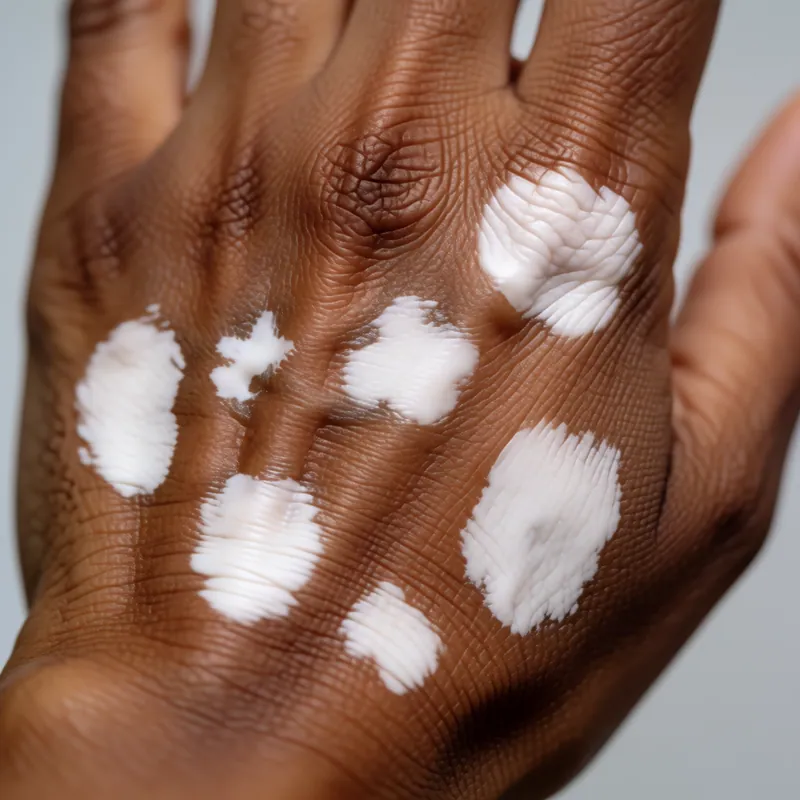
In vitiligo the immune system destroys the pigment-producing cells in patches of skin, leaving areas that are completely without pigment and sharply demarcated from the skin around them. It commonly affects the hands, the face — especially around the eyes and mouth — the armpits, the groin and areas that have been injured. It is not contagious in any way, it is not caused by anything in a diet, and it is not caused by anything the patient did.
The psychological and social weight of this condition is frequently far greater than its physical effect, and it is greater the more contrast there is between the patches and the surrounding skin — which means it falls hardest on people with deeper skin tones. It attracts staring, questions and, in some communities, real stigma. That is treated here as part of the condition rather than as something outside the appointment, and it is a legitimate reason to pursue active treatment rather than to be told it is harmless.
Treatment has two aims, and they are separable: stopping the spread, and bringing pigment back. Halting progression is achievable for most people. Repigmentation is genuinely possible, it is slow — six months to see meaningful change — and it varies enormously by site. The face and neck respond well. The hands, the feet and the lips respond poorly, and areas of white hair within a patch respond least of all, because the reservoir of pigment cells lives in the hair follicles.
Treatment options
Frequently combined, because phototherapy plus a topical agent works better than either alone.
Topical steroids and steroid-free anti-inflammatory creams
First-line for limited disease. The steroid-free options are particularly suited to the face and eyelids, where they can be used long-term without a thinning risk, and the face is also the site that responds best — a useful combination.
Newer targeted topical treatment
A class of cream that blocks the specific immune signalling driving the pigment cell destruction is now available for vitiligo, and it represents a real change in what can be offered. It requires months of consistent use and monitoring, and results are best on the face.
Narrowband ultraviolet phototherapy
The mainstay for widespread vitiligo. Two or three times a week in the booth here, over a course of many months, and it both slows progression and stimulates repigmentation. It is a serious time commitment and it is the most effective option for extensive disease. Combined with a topical agent it works better than either alone. See /phototherapy.html.
Targeted phototherapy for small areas
A hand-held device treating individual patches rather than the whole body, which avoids exposing unaffected skin. Useful for limited disease.
Systemic treatment for rapidly spreading disease
Where vitiligo is advancing quickly, a short course of systemic treatment can halt it. That is a different objective from repigmenting, and it is time-critical — rapid spread is a reason to be seen promptly.
Camouflage, which is not a consolation prize
Well-matched cosmetic camouflage and self-tanning preparations are genuinely useful, they are immediate, and for patches on hands and face that respond poorly to treatment they may be the most effective thing available. Choosing camouflage over years of treatment is a rational decision and nobody here will treat it as giving up.
Sun protection over depigmented skin
Skin without pigment burns readily and has no protection at all. Patches need diligent sunscreen — and tanning the surrounding skin increases the contrast, which makes the patches more noticeable.
What to expect, honestly
The parts that are frequently left out of an initial conversation.
Repigmentation is slow and starts in specks
It appears as small pigmented dots within a patch, usually around hair follicles, which then enlarge and join up. Six months of consistent treatment before judging it is the realistic timeframe, and the speckled intermediate stage surprises people who expected the edges to close in.
Site matters more than anything else
Face and neck respond best. Trunk moderately. Hands, feet, lips and the tips of fingers respond poorly. Patches where the hair has also turned white respond least, because the pigment cell reservoir in the follicle has gone.
It can relapse
Repigmented areas may lose pigment again, particularly if treatment stops entirely. Maintenance is part of the plan rather than an afterthought.
Associated autoimmune conditions are worth checking
Thyroid disease in particular is meaningfully more common in people with vitiligo, and thyroid function is checked at diagnosis and periodically afterwards. Others are less common but worth keeping in mind.
Depigmentation of remaining skin is an option only in extensive disease
Where vitiligo covers most of the body, removing the remaining pigment to achieve an even colour is occasionally chosen. It is permanent and irreversible, it is a major decision, and it is not undertaken lightly or quickly.
Vitiligo in western Queens
An autoimmune condition in which pigment cells are lost, producing well-defined pale patches. It is not contagious, it is not caused by diet, and treatment has genuinely improved — repigmentation is possible, slow, and better at some sites than others.
Every appointment here starts the same way: a proper history, an examination in good light, and a named diagnosis said out loud and written down for you to take home. If there is genuine doubt you will be told that, and told what would settle it — usually a biopsy. You leave with a plan that has a strength, a site, a frequency and a date to stop or come back on it, and, where the condition is one that relapses, what to do on the first day of the next flare. If the honest answer is that this is better left alone, or that it belongs somewhere other than here, that is what you get instead, and it costs exactly the same.

This page is not medical advice, and it is not a diagnosis. Nothing on this website is medical advice for you in particular, and it is not a diagnosis. These pages describe conditions in general terms so that you arrive knowing what the questions are — they cannot tell you which condition you have, because that requires somebody to look at your skin, feel it, ask you a hundred questions and frequently take a sample of it. Two conditions on this website can look identical in a photograph and need opposite treatments. If something on your skin is new, changing, painful or not healing, the useful next step is an appointment rather than more reading.
No before-and-after photographs, and no promised outcome. There are no before-and-after photographs on this website and there never will be. Every set you have seen somewhere else was chosen from a much larger pile, and the second picture is usually taken in different light, at a different angle, at a different point in a flare cycle. In dermatology the dishonesty is sharper than in most fields, because nearly every condition here fluctuates on its own — photograph any relapsing skin disease at its worst and again at its best and you have a persuasive pair of images that demonstrates nothing about the treatment in between. What we publish instead is what a treatment typically achieves, in how long, in what proportion of people, and how often it does not work.
The risks, plainly. Every treatment described here has side effects, and some carry real risks. Topical steroids thin skin if they are used at the wrong strength on the wrong site for too long, which is why they are prescribed with a site, a strength and a stopping point rather than handed over indefinitely. Light-based and laser treatment can burn, blister and cause pigment change that lasts months, and that risk is higher on deeper skin tones and on recently tanned skin. Any procedure that breaks the skin can bleed, become infected and leave a scar; on the chest, the shoulders and the jawline, scars are more likely to thicken. Several of the medicines used in this speciality require blood tests, and some cannot be taken during pregnancy. We tell you your own risk rather than the average one, and where the honest answer is that a condition is better left alone, that is the advice you will get.
Nothing is diagnosed from a photograph. We do not diagnose skin from photographs, and we do not answer "what is this?" by email, by message or through a form. This is not caution for its own sake. A photograph has no history attached to it, cannot be felt, cannot be stretched or pressed to see whether the colour blanches, cannot be examined under a dermatoscope, and misreports colour badly — which matters enormously on skin that is not pale. The examination that actually distinguishes a harmless growth from an early cancer involves magnification, cross-polarised light and, when there is any doubt at all, a biopsy. An application that offers to tell you whether a mole is dangerous from a picture taken on a telephone is selling reassurance, and reassurance is the one product in this field that is dangerous when it is wrong. Bring the mark to a room where somebody can look at it.
Questions
Vitiligo — the questions we are asked most
Is vitiligo contagious?
No, absolutely not, and it cannot be passed on by any kind of contact. It is an autoimmune condition in which the body's own immune system destroys pigment cells. It is asked about often enough — usually by somebody who has been avoided or questioned — that it belongs first on this list.
Will the pigment come back?
Often, partially, slowly, and it depends heavily on the site. The face and neck respond well; hands, feet and lips respond poorly; patches where the hair has also gone white respond least. Six months of consistent treatment before judging is realistic, and repigmentation appears as specks that enlarge rather than as edges closing in.
Can it be cured?
No. Treatment stops the spread and brings pigment back at responsive sites, and it can relapse if treatment stops entirely. Stability is the more useful goal to hold onto than clearance, and for many people that is genuinely achievable.
Is it caused by stress or by something I ate?
No. It is autoimmune. Stress is reported by some people as preceding a flare, which is not the same as causing the condition, and no diet causes or cures it. There is a great deal sold on the internet based on the opposite claim.
Should I have any other tests?
Thyroid function, yes — thyroid disease is meaningfully more common in people with vitiligo, and it is checked at diagnosis and periodically afterwards. Beyond that, testing is guided by whether you have other symptoms rather than done as a broad screen.
My patches are spreading quickly. Does that change anything?
Yes, and it is a reason to be seen promptly rather than at the next routine slot. Rapidly progressing vitiligo can be halted with a short course of systemic treatment, and stopping the spread is a separate and more time-critical objective than bringing pigment back.
Is using makeup or self-tan to cover it giving up?
No. Well-matched camouflage is immediate, effective, and for patches at sites that respond poorly it may be the most useful thing available. Choosing it over years of treatment is a rational decision and it will be supported here rather than gently discouraged.
Related
Often seen alongside this
Pigment & Skin Tone
Marks After Inflammation
The brown, grey or purple marks left behind by acne, eczema, an injury or an insect bite. They are not scars and they do fade — slowly, over six to eighteen months, and far faster with daily sun protection than with anything else.
Read more
Pigment & Skin Tone
Melasma
Symmetrical brown patches across the cheeks, forehead and upper lip, driven by hormones and light. It is the most stubborn pigmentation in dermatology, it relapses reliably, and daily sun protection is not advice here — it is the treatment.
Read more
Pigment & Skin Tone
Skin of Color Dermatology
Not a separate speciality — a set of things that are genuinely different and that this field's defaults were not built around. Redness reads differently, pigment change is the presenting complaint more often than the disease, and every light-based treatment carries different risk.
Read moreA named diagnosis and a written plan you leave holding
Book an appointment
Pick a physician and a time from the calendar — it shows only the hours each of them genuinely has free. A new patient appointment is thirty minutes, a full skin examination forty-five, and you leave with a named diagnosis written down. If something on your skin has changed, telephone instead and say that word: it is triaged differently.