
Some things should not wait for the next free routine appointment. Some things should not wait for the next free routine appointment. Telephone the practice and say what is happening, or go to an emergency room, if you have a mole or a mark that has changed shape, colour or size, that has become raised or uneven, or that bleeds, itches or will not heal; a sore anywhere that has not healed in three weeks; a rash that is spreading quickly, especially with fever, blistering, or peeling skin; a painful rash in a band on one side of the body, particularly near an eye; redness that is hot, swollen, tender and spreading, which can be a deep skin infection; a new rash after starting a medicine, especially with mouth or eye involvement; or a child under three months with any widespread rash. If you have been treated here and something is worse rather than better after a procedure, telephone us rather than waiting for the review appointment. We would far rather field a call that turns out to be nothing.
Hyperhidrosis is sweating substantially beyond what is needed to regulate temperature. The primary form usually begins in adolescence or earlier, affects specific sites — the underarms, palms, soles, face or scalp — is generally symmetrical, and characteristically stops during sleep. It often runs in families. It is not caused by anxiety, though it certainly causes it, and that direction of causation gets reversed so routinely that many patients arrive having been told to relax.
The distinction that matters clinically is between this and secondary hyperhidrosis: sweating that is generalised rather than confined to particular sites, that began in adulthood, that occurs at night, or that comes with weight loss, fevers or feeling unwell. That pattern can reflect a thyroid problem, a hormonal change, an infection, a medicine or something else that needs investigating, and it is asked about at every appointment for exactly that reason.
The effect on life is consistently underestimated by everybody except the person who has it. Patients describe choosing clothes by how well they hide sweat, avoiding handshakes, being unable to hold paper or use a touchscreen reliably, and turning down work or social occasions. It is worth stating that this is a sufficient reason to treat it — nobody needs to justify wanting this dealt with.
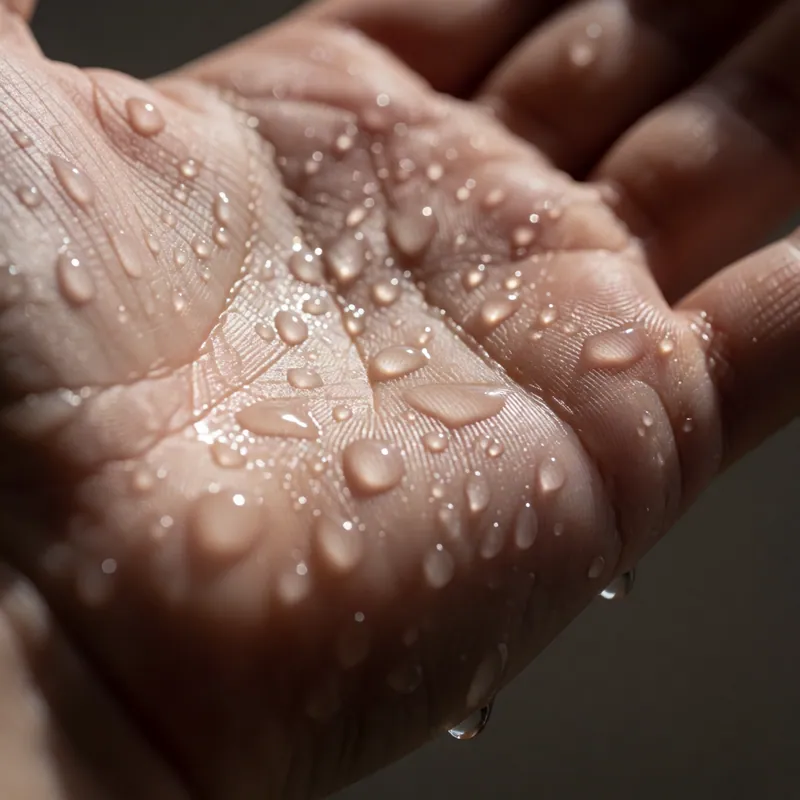
The treatment ladder
Starting with the simplest, escalating on effect rather than on time served.
Aluminium-based antiperspirant, used correctly
Which almost nobody does. It must go on completely dry skin at night, when sweat production is lowest, and be washed off in the morning — applied to damp skin in the morning it does very little and irritates. Prescription-strength versions are considerably more effective than what is sold in shops. Irritation is the main limitation and is reduced by using it every second or third night once control is achieved.
Iontophoresis, for hands and feet
Passing a weak electrical current through water in which the hands or feet are immersed, for about twenty minutes, several times a week initially and then as maintenance. It is unglamorous and genuinely effective for palmar and plantar sweating, it has no systemic effects, and a home device makes it practical long-term.
Injections that block the nerve signal to sweat glands
Small injections across the affected area, most commonly the underarms, which stop the chemical signal reaching the sweat glands. Highly effective, with the effect lasting several months before repeating. For the palms it works too and requires either a nerve block or considerable tolerance, because the injections there are genuinely uncomfortable. Frequently treated as cosmetic by insurers even where the condition is clearly medical, and you will be told the position before it happens.
Topical anticholinergic preparations
Wipes and creams that block the same signal, applied to the affected area. Useful for underarms and for the face, with dry mouth and blurred vision possible if enough is absorbed — so hands are washed afterwards and it is kept away from the eyes.
Oral tablets
Medicines that reduce sweating across the whole body, useful where sweating is generalised or multiple sites are affected. Side effects — dry mouth, dry eyes, blurred vision, constipation, and heat intolerance — are dose-related and limit how many people continue them. Reduced ability to sweat matters in hot weather and during exercise, which is a real safety point rather than a footnote.
Surgery, as a last resort with a specific caveat
Interrupting the nerve supply is effective for palmar sweating and is referred out. The caveat is compensatory sweating — increased sweating elsewhere on the body, common afterwards and occasionally worse than the original problem, and irreversible. It is a genuine option for severely affected people after other treatments have failed, and it should never be a first move.
When sweating needs investigating rather than treating
The features that change this from a skin problem into a general medical one.
It started in adulthood
Primary hyperhidrosis nearly always begins in childhood or adolescence. A new onset in an adult is worth explaining rather than simply treating.
It is generalised rather than site-specific
All over, rather than confined to underarms, palms, soles or face.
It happens at night
Primary hyperhidrosis characteristically stops during sleep. Night sweats are a different symptom and need a general medical assessment.
It comes with other symptoms
Weight loss, fever, palpitations, tremor, feeling unwell, or a change in your general health. Thyroid disease, infection, hormonal change and some medicines all cause sweating.
It is on one side only
Asymmetrical sweating is unusual in the primary form and occasionally indicates a neurological cause.
Excessive Sweating in western Queens
Sweating far beyond what temperature requires, enough to change what you wear and what you avoid. It is a recognised medical condition with a ladder of treatments, and it is not a sign of poor hygiene or nervousness.
Every appointment here starts the same way: a proper history, an examination in good light, and a named diagnosis said out loud and written down for you to take home. If there is genuine doubt you will be told that, and told what would settle it — usually a biopsy. You leave with a plan that has a strength, a site, a frequency and a date to stop or come back on it, and, where the condition is one that relapses, what to do on the first day of the next flare. If the honest answer is that this is better left alone, or that it belongs somewhere other than here, that is what you get instead, and it costs exactly the same.

This page is not medical advice, and it is not a diagnosis. Nothing on this website is medical advice for you in particular, and it is not a diagnosis. These pages describe conditions in general terms so that you arrive knowing what the questions are — they cannot tell you which condition you have, because that requires somebody to look at your skin, feel it, ask you a hundred questions and frequently take a sample of it. Two conditions on this website can look identical in a photograph and need opposite treatments. If something on your skin is new, changing, painful or not healing, the useful next step is an appointment rather than more reading.
No before-and-after photographs, and no promised outcome. There are no before-and-after photographs on this website and there never will be. Every set you have seen somewhere else was chosen from a much larger pile, and the second picture is usually taken in different light, at a different angle, at a different point in a flare cycle. In dermatology the dishonesty is sharper than in most fields, because nearly every condition here fluctuates on its own — photograph any relapsing skin disease at its worst and again at its best and you have a persuasive pair of images that demonstrates nothing about the treatment in between. What we publish instead is what a treatment typically achieves, in how long, in what proportion of people, and how often it does not work.
The risks, plainly. Every treatment described here has side effects, and some carry real risks. Topical steroids thin skin if they are used at the wrong strength on the wrong site for too long, which is why they are prescribed with a site, a strength and a stopping point rather than handed over indefinitely. Light-based and laser treatment can burn, blister and cause pigment change that lasts months, and that risk is higher on deeper skin tones and on recently tanned skin. Any procedure that breaks the skin can bleed, become infected and leave a scar; on the chest, the shoulders and the jawline, scars are more likely to thicken. Several of the medicines used in this speciality require blood tests, and some cannot be taken during pregnancy. We tell you your own risk rather than the average one, and where the honest answer is that a condition is better left alone, that is the advice you will get.
Nothing is diagnosed from a photograph. We do not diagnose skin from photographs, and we do not answer "what is this?" by email, by message or through a form. This is not caution for its own sake. A photograph has no history attached to it, cannot be felt, cannot be stretched or pressed to see whether the colour blanches, cannot be examined under a dermatoscope, and misreports colour badly — which matters enormously on skin that is not pale. The examination that actually distinguishes a harmless growth from an early cancer involves magnification, cross-polarised light and, when there is any doubt at all, a biopsy. An application that offers to tell you whether a mole is dangerous from a picture taken on a telephone is selling reassurance, and reassurance is the one product in this field that is dangerous when it is wrong. Bring the mark to a room where somebody can look at it.
Questions
Excessive Sweating — the questions we are asked most
Is this caused by anxiety?
No, and the assumption causes real harm. Primary hyperhidrosis is a disorder of sweat gland activation that usually starts in childhood or adolescence and often runs in families. It certainly causes anxiety — worrying about visible sweat makes you sweat more — but the direction of causation is backwards in most of the advice people are given.
Am I just sweating a normal amount and being over-sensitive?
If it is soaking through clothing, dripping from your hands, making it difficult to hold paper or use a touchscreen, or determining what you wear and what you avoid, that is not the ordinary range. It is a recognised condition and you do not need to justify wanting it treated.
What is the most effective treatment?
It depends on the site. For underarms, prescription-strength antiperspirant used correctly at night, then injections. For hands and feet, iontophoresis is genuinely effective and under-used. For multiple sites or generalised sweating, oral tablets. Most people can be substantially improved; the ladder exists because different sites respond to different things.
How long do the injections last?
Several months for the underarms, then the treatment is repeated. For palms the effect is similar and the injections themselves are considerably more uncomfortable, so a nerve block is often used. Coverage varies — insurers frequently treat this as cosmetic even where the condition is plainly medical, and you will be told the position beforehand.
I sweat at night, soaking the sheets. Is that the same thing?
No, and it matters. Primary hyperhidrosis characteristically stops during sleep. Night sweats are a different symptom that needs a general medical assessment — thyroid disease, infection, hormonal change and certain medicines all cause them, and that is a conversation to have with your physician as well as with us.
Is the surgery worth it?
For a small number of severely affected people whose palms have not responded to anything else, yes. The caveat is compensatory sweating — increased sweating elsewhere on the body, which is common, is occasionally worse than the original problem, and cannot be reversed. It is a last resort, it is referred out, and anybody offering it before iontophoresis and injections has been tried is skipping the ladder.
Related
Often seen alongside this
Hair, Nails & Sweat
Hair Loss
Around twenty different causes that look similar to a patient and quite different under magnification. The question that governs everything is whether the scalp is scarred, because scarring is permanent and the window to prevent it is while the condition is still active.
Read more
Hair, Nails & Sweat
Nail Disorders
Thickened, discoloured, crumbling or lifting nails. About half of what is assumed to be fungus is not, which is why nails are sampled here before treatment rather than after months of it.
Read more
Hair, Nails & Sweat
Fungal Skin Infections
Ringworm, athlete's foot, jock itch and yeast infections in the folds. Straightforward to treat once correctly identified — and routinely made much worse by a steroid cream applied in good faith.
Read moreA named diagnosis and a written plan you leave holding
Book an appointment
Pick a physician and a time from the calendar — it shows only the hours each of them genuinely has free. A new patient appointment is thirty minutes, a full skin examination forty-five, and you leave with a named diagnosis written down. If something on your skin has changed, telephone instead and say that word: it is triaged differently.