
Some things should not wait for the next free routine appointment. Some things should not wait for the next free routine appointment. Telephone the practice and say what is happening, or go to an emergency room, if you have a mole or a mark that has changed shape, colour or size, that has become raised or uneven, or that bleeds, itches or will not heal; a sore anywhere that has not healed in three weeks; a rash that is spreading quickly, especially with fever, blistering, or peeling skin; a painful rash in a band on one side of the body, particularly near an eye; redness that is hot, swollen, tender and spreading, which can be a deep skin infection; a new rash after starting a medicine, especially with mouth or eye involvement; or a child under three months with any widespread rash. If you have been treated here and something is worse rather than better after a procedure, telephone us rather than waiting for the review appointment. We would far rather field a call that turns out to be nothing.
A normal scar is red and firm for several weeks, then remodels over six to twelve months into something paler and flatter. Judging any scar before a year has passed is judging it in the middle of that process, which is why nobody should be offered scar revision at two months.
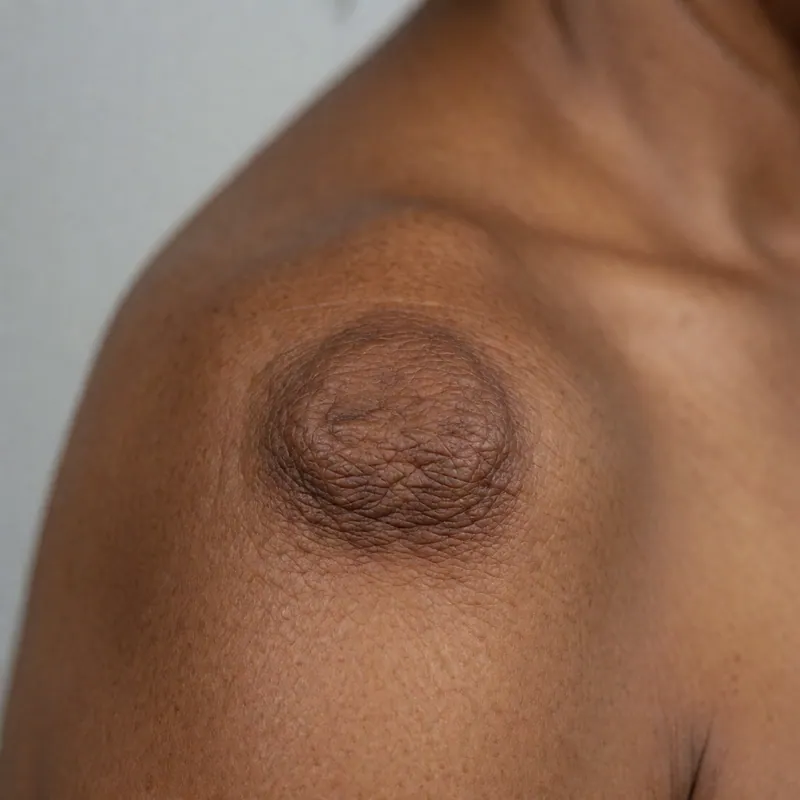
Two kinds of scar do not follow that path. A hypertrophic scar is raised and firm but stays within the boundary of the original wound, and it frequently improves substantially on its own over a year or two. A keloid grows beyond the boundary of the original injury, invading normal skin around it, and it does not resolve on its own — it is far more common on deeply pigmented skin, tends to run in families, and favours the chest, shoulders, upper back, jawline and earlobes. Keloids frequently itch and hurt, which is worth saying because it is often dismissed as a cosmetic complaint when it is not.
The single most important fact about keloids is that surgery alone makes them worse. Cutting a keloid out creates a new wound in somebody who forms keloids, and the recurrence is usually larger than the original. Excision has a role only as part of a combined plan with immediate additional treatment. If somebody offers to simply cut a keloid off, that is a reason to seek another opinion.
Treatment options
Usually combined, and always over months rather than weeks.
Steroid injection into the scar
The mainstay for keloids and thickened scars. Injected directly into the scar tissue every four to six weeks, over several sessions, flattening and softening it and usually relieving the itch and pain quickly — the symptom relief often arrives well before the visible change. It is uncomfortable, because the tissue is dense. It can leave a dent or a pale halo at the site, which usually recovers over months.
Silicone gel or sheeting
One of the few non-prescription measures with reasonable evidence behind it. Worn over the scar for many hours a day across months. Unexciting, cheap, and worth doing consistently — consistency is where it usually fails.
Pressure
Particularly effective for earlobe keloids after removal, using pressure earrings worn for months. Also used for scars elsewhere with pressure garments.
Combined excision and immediate follow-on treatment
Where a keloid is large, surgery may be part of the plan — but only combined with injections or other treatment started immediately afterwards and continued for months. Excision alone in a keloid-former reliably produces a larger keloid.
Other injected agents for resistant keloids
Certain other injectable medicines are used, alone or combined with steroid, for keloids that have not responded. These are for the resistant cases.
Laser, as an adjunct
Vascular laser can reduce the redness of a scar and some resurfacing lasers improve texture. On deeper skin tones the pigment risk is real and the settings must be conservative. It is an adjunct to the above rather than a substitute.
For acne scarring, a different set of tools
Dents and pits from acne are treated with microneedling, resurfacing, subcision or filling depending on the type. The order rule applies absolutely: the acne must be controlled first, or new marks are created while old ones are treated.
Prevention, which is the most effective thing on this page
For anybody who knows they scar badly, this matters more than any treatment afterwards.
Tell us before any procedure
If you or your family form keloids, that changes whether an elective procedure is worth doing at all, where a biopsy is sited when there is a choice, the technique used, and whether preventive treatment starts immediately rather than once a scar has thickened.
Reconsider elective procedures on high-risk sites
The chest, shoulders, upper back, jawline and earlobes. For a harmless lesion on one of those sites in somebody who keloids, leaving it alone is frequently the better answer, and that is advice we give regularly.
Keep tension off a healing wound
No lifting, stretching or vigorous exercise for two weeks, longer on the trunk. Tension across a healing wound is one of the strongest drivers of a widened or thickened scar.
Start silicone early, once healed
From about three weeks, and continue for months. Combined with massage.
Sun protection on a new scar for a year
New scar tissue pigments readily and a scar exposed to sun in its first year can darken permanently. This is one of the few pieces of scar advice with a clear effect.
Think carefully about ear piercing if you keloid
Earlobe keloids after piercing are among the commonest, and a second piercing after one keloid has formed is very likely to produce another.
Scars & Keloids in western Queens
Scars are improved, not removed, and that word is chosen deliberately. Keloids can be flattened and softened with a course of injections, and the most effective thing available is preventing them in the first place.
Every appointment here starts the same way: a proper history, an examination in good light, and a named diagnosis said out loud and written down for you to take home. If there is genuine doubt you will be told that, and told what would settle it — usually a biopsy. You leave with a plan that has a strength, a site, a frequency and a date to stop or come back on it, and, where the condition is one that relapses, what to do on the first day of the next flare. If the honest answer is that this is better left alone, or that it belongs somewhere other than here, that is what you get instead, and it costs exactly the same.
This page is not medical advice, and it is not a diagnosis. Nothing on this website is medical advice for you in particular, and it is not a diagnosis. These pages describe conditions in general terms so that you arrive knowing what the questions are — they cannot tell you which condition you have, because that requires somebody to look at your skin, feel it, ask you a hundred questions and frequently take a sample of it. Two conditions on this website can look identical in a photograph and need opposite treatments. If something on your skin is new, changing, painful or not healing, the useful next step is an appointment rather than more reading.
No before-and-after photographs, and no promised outcome. There are no before-and-after photographs on this website and there never will be. Every set you have seen somewhere else was chosen from a much larger pile, and the second picture is usually taken in different light, at a different angle, at a different point in a flare cycle. In dermatology the dishonesty is sharper than in most fields, because nearly every condition here fluctuates on its own — photograph any relapsing skin disease at its worst and again at its best and you have a persuasive pair of images that demonstrates nothing about the treatment in between. What we publish instead is what a treatment typically achieves, in how long, in what proportion of people, and how often it does not work.
The risks, plainly. Every treatment described here has side effects, and some carry real risks. Topical steroids thin skin if they are used at the wrong strength on the wrong site for too long, which is why they are prescribed with a site, a strength and a stopping point rather than handed over indefinitely. Light-based and laser treatment can burn, blister and cause pigment change that lasts months, and that risk is higher on deeper skin tones and on recently tanned skin. Any procedure that breaks the skin can bleed, become infected and leave a scar; on the chest, the shoulders and the jawline, scars are more likely to thicken. Several of the medicines used in this speciality require blood tests, and some cannot be taken during pregnancy. We tell you your own risk rather than the average one, and where the honest answer is that a condition is better left alone, that is the advice you will get.
Nothing is diagnosed from a photograph. We do not diagnose skin from photographs, and we do not answer "what is this?" by email, by message or through a form. This is not caution for its own sake. A photograph has no history attached to it, cannot be felt, cannot be stretched or pressed to see whether the colour blanches, cannot be examined under a dermatoscope, and misreports colour badly — which matters enormously on skin that is not pale. The examination that actually distinguishes a harmless growth from an early cancer involves magnification, cross-polarised light and, when there is any doubt at all, a biopsy. An application that offers to tell you whether a mole is dangerous from a picture taken on a telephone is selling reassurance, and reassurance is the one product in this field that is dangerous when it is wrong. Bring the mark to a room where somebody can look at it.
Questions
Scars & Keloids — the questions we are asked most
Can you remove my scar completely?
No, and anybody saying otherwise is overselling. Scars are improved — made flatter, softer, paler, less itchy and less noticeable. They are not removed, because tissue has been permanently altered. Improved is a genuinely worthwhile outcome and it is the honest word for it.
What is the difference between a keloid and an ordinary raised scar?
A hypertrophic scar is raised but stays within the boundary of the original wound and often improves substantially on its own over a year or two. A keloid grows beyond that boundary into normal skin and does not resolve on its own. Keloids are considerably more common on deeply pigmented skin, run in families, and favour the chest, shoulders, upper back, jawline and earlobes.
Can you just cut the keloid off?
Not on its own — that reliably makes it worse. Cutting a keloid out creates a fresh wound in somebody who forms keloids, and the recurrence is usually larger than the original. Excision has a role only combined with injections or other treatment started immediately and continued for months. If somebody offers to simply cut it off, get another opinion.
Do the injections hurt?
Yes, somewhat, because the tissue is dense and resists the injection. It is brief. The itch and pain of a keloid frequently settle within days of the first session, well before any visible flattening, which is usually what people notice first.
How long before I see a difference?
Several sessions at four to six week intervals, so months. Symptom relief comes sooner than appearance. Separately, any new scar should be given a full year before it is judged at all — it is at its reddest and firmest at around six weeks, which is exactly when people conclude it has gone wrong.
I keloid. Should I avoid having anything removed?
It changes the calculation rather than closing it. For a harmless lesion on a high-risk site, leaving it alone is frequently the better answer and we will say so. Where something genuinely needs removing, the technique, the siting and starting preventive treatment immediately all reduce the risk meaningfully. Tell us before rather than after.
Related
Often seen alongside this
Procedures & Testing
Skin Biopsy
Taking a small sample of skin so a pathologist can say what is actually happening in it. Fifteen minutes, local anaesthetic, a result in about a week — and we telephone you either way, including when the news is good.
Read more
Procedures & Testing
Cryotherapy
Liquid nitrogen, applied in short bursts, to freeze off sun-damage patches, warts and several harmless growths. Quick and effective. It stings for twenty seconds and it usually leaves a pale mark — which on deeper skin tones can be permanent.
Read more
Procedures & Testing
Cyst & Lipoma Removal
Removing a cyst or a fatty lump under local anaesthetic. Both are harmless; both are worth removing when they are growing, catching or repeatedly inflamed. The timing matters — an inflamed cyst is settled first and removed later.
Read moreA named diagnosis and a written plan you leave holding
Book an appointment
Pick a physician and a time from the calendar — it shows only the hours each of them genuinely has free. A new patient appointment is thirty minutes, a full skin examination forty-five, and you leave with a named diagnosis written down. If something on your skin has changed, telephone instead and say that word: it is triaged differently.